

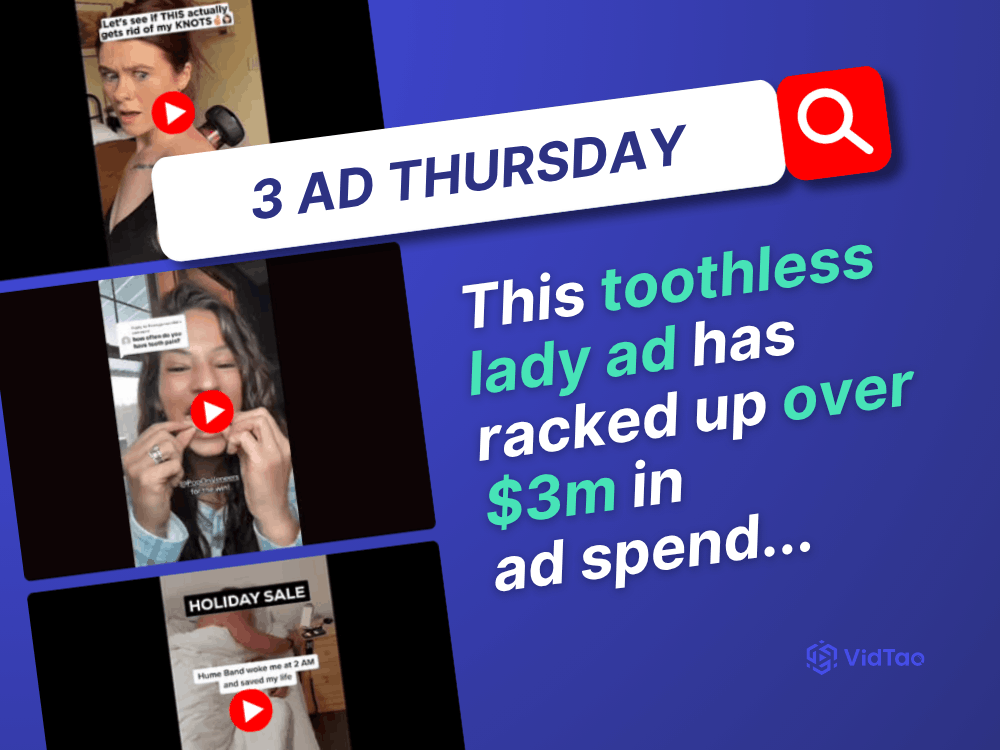
Welcome to, or welcome back to this week’s VidTao 3 Ad Thursday, where each week we’ll be diving into our VidTao ad intelligence software to uncover 3 high-performing YouTube ads driving results!
This week we’ve got three high-performing YouTube ads for you to check out & model, including:
 AI health monitoring wearable ad with over $1.8M in ad spend…
 Pop-on veneers ad with over $3m dollars in ad spend…
 Pain relief device ad with over $1.3 million in ad spend…
Ready to check the ads out?
The tracking metric you've never heard of that 4x'd a $750M business 
99% of DTC Subscription brands miss this
Duolingo was stuck in 2018.
Yes, $750M in revenue & 40 million+ daily users…
But growth?
Flatlining.
Hundreds of tests running… Nothing moving the needle.
They were trapped optimizing metrics everyone tracks: conversion rates, retention rates, acquisition costs.
Then they used a framework that flips traditional tracking on its head…
…exposing the ONE metric that mattered most...
…buried in every DTC subscription brand's biggest blind spot.
When they tested it against everything else — new user acquisition, reactivation campaigns, onboarding flows — this one metric had 10x more impact than all of them.
The result?
4x growth.
Not from better ads. Not from new traffic sources. Not from a rebrand.
From tracking one transition that 99% of subscription brands completely ignore.
Want to see how you can uncover your DTC subscription business’s “magic metric”?
VidTao Co-Founder Brat Vukovich just wrote an article inside his weekly newsletter, The Dashboard, walking you through exactly how to dig into your own subscription business and uncover this golden insight.

PS — The Dashboard is where Brat shares weekly notes on building BraTrax, buying media, and making sense of performance data - without the fluff.
PPS — Send this link to a friend who needs it: blog.bratrax.com
Let's dive right in and take a closer look at this week's YouTube ad standouts and discover what makes them so successful.
AI health monitoring wearable ad with over $1.8M in ad spend (Hume Health)
The first ad that caught our attention while browsing VidTao during this week was this AI health monitoring wearable ad, check it out:
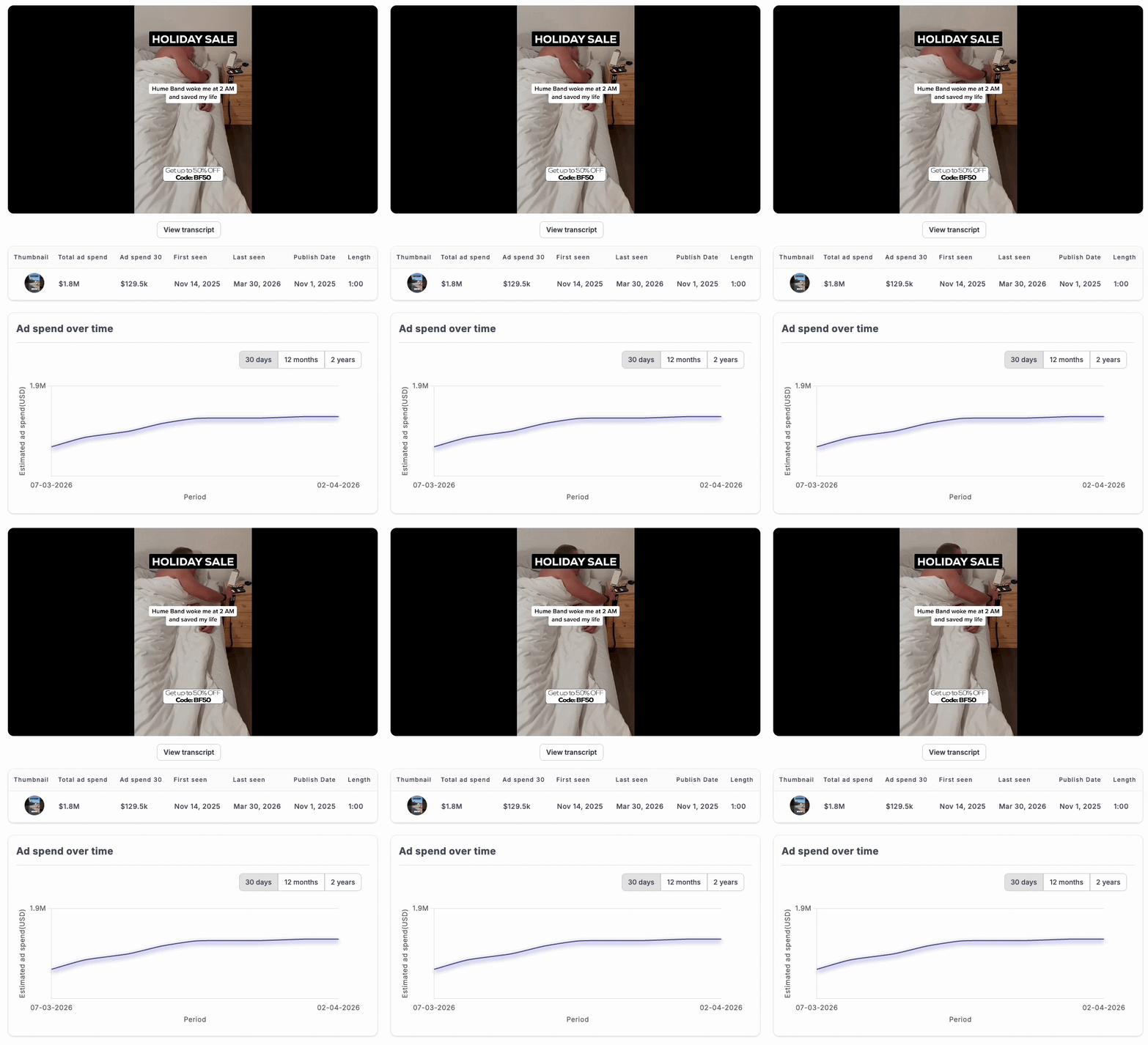
This ad’s estimated ad spend is over $1.8M! 
Here are some of the elements this ad consists of:
 Opening Hook
"My Hume band started alerting me at 2 AM and it might have saved my life."
"2 AM" is doing more work than it looks like. It's not just a time - it's a moment of total vulnerability, when the viewer is asleep and unguarded. The specificity makes it feel like a real memory, not a script. "Might have saved my life" is more credible than "saved my life" - the hedge actually increases trust.
 Credibility Inoculation
"I ran marathons, ate Mediterranean, perfect checkups every year."
This sequence is the most strategically important part of the entire ad. It preemptively destroys the viewer's #1 defense mechanism - "that won't happen to me, I'm healthy." By establishing the speaker as someone who did everything right and still nearly died, the ad makes every viewer feel equally vulnerable regardless of their lifestyle. No one can opt out of the fear.
 The Detection Moment
"Irregular patterns... metabolic momentum dropping fast... AI flagged it as urgent... artery 85% blocked... 2 weeks from a fatal heart attack."
Each detail escalates the stakes. "Metabolic momentum dropping fast" sounds like a dashboard reading - clinical, specific, real. "2 weeks from a fatal heart attack. All while I felt completely fine." That last line is the emotional core of the entire ad - invisible danger is the most terrifying kind because it removes the safety net of symptoms entirely.
 Competitor Contrast
"My Fitbit showed 10,000 steps. The Hume band showed I might be dying."
The best single line in this series. It doesn't attack Fitbit - it just places two readings next to each other and lets the viewer reach the conclusion themselves. "10,000 steps" is the universally recognized symbol of feeling healthy. Using it as the punchline of a near-death story reframes every other wearable as dangerously superficial.
 Product Capability Stack
"Metabolic capacity, cellular stress, early illness patterns. It's like having an ICU monitor on your wrist."
"ICU monitor on your wrist" is the product positioning in five words - it's not a fitness tracker, it's a medical device you own. "Predicts instead of just records" is the key differentiator cleanly articulated - every other wearable tells you what happened; Hume tells you what's coming.
 Family Proof Expansion
"Caught my prediabetes and my wife's thyroid issue."
Expanding the testimonial to cover two additional family members with two completely different conditions signals product versatility without a single feature bullet. It also shifts the buyer from "should I get this for myself" to "should I get this for my whole family" - a much larger purchase decision naturally introduced.
 Cost Reframe Close
"One cardiac event costs $100,000. This Hume band costs a fraction of that."
Anchoring price against a $100,000 catastrophe rather than against a $300 Apple Watch is a masterstroke. It makes the purchase feel like financial responsibility rather than discretionary spending. "Don't wait for symptoms" is the CTA and the product philosophy in one line - it reframes inaction as the dangerous choice.
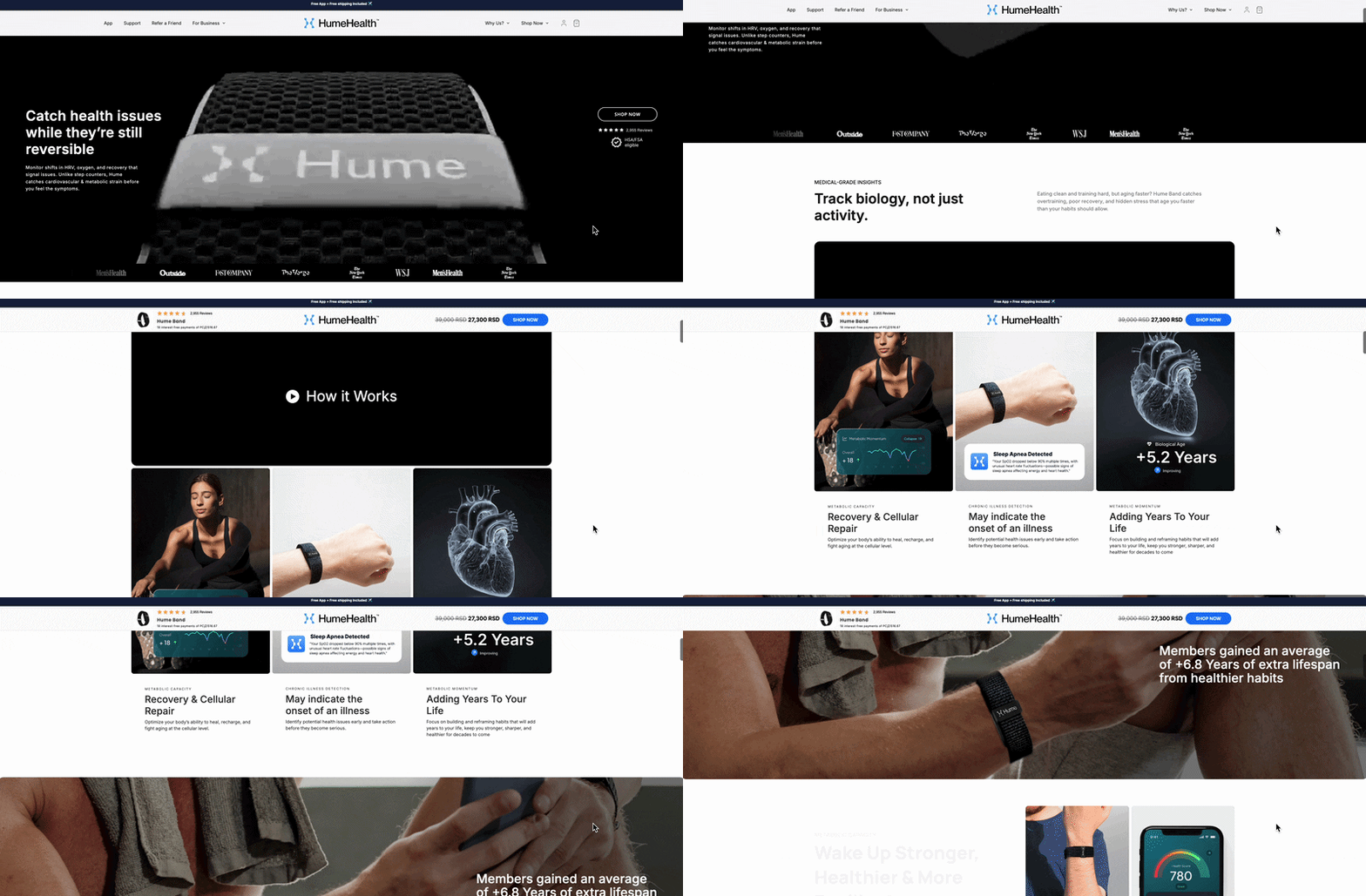
Here’s a quick look at this advertiser’s landing page as well:
 Takeaways
 Destroy the "it won't happen to me" objection first — establishing the speaker as someone healthy who nearly died removes every viewer's ability to self-exempt from the threat
 Invisible danger is the most powerful fear trigger — "I felt completely fine" is more frightening than any symptom description because it eliminates the false security of feeling okay
 Side-by-side competitor contrast beats direct attacks — "Fitbit: 10,000 steps / Hume: might be dying" does more damage than any negative claim ever could
 Stack multiple detection stories to signal versatility — artery blockage, prediabetes, thyroid issue in one ad covers three completely different buyer fears simultaneously
 Anchor price against catastrophe, not competition — "$100,000 cardiac event vs. a fraction of that" reframes the purchase as insurance, not spending
 "Predicts instead of records" is a positioning line worth stealing — any product that's proactive rather than reactive can use this framework to differentiate instantly
 "Spy" on 34.3 Million YouTube Ads
(and Landing Pages)!
Unlock proven strategies for success with the VidTao Premium YouTube Ad Library. Get instant access to your FREE VidTao trial today 
 Claim Your FREE VidTao Trial Now!
Take the guesswork out of YouTube ads – start scaling smarter.
Pop-on veneers ad with over $3m dollars in ad spend
Next up - this unusual ad for pop-on veneers:
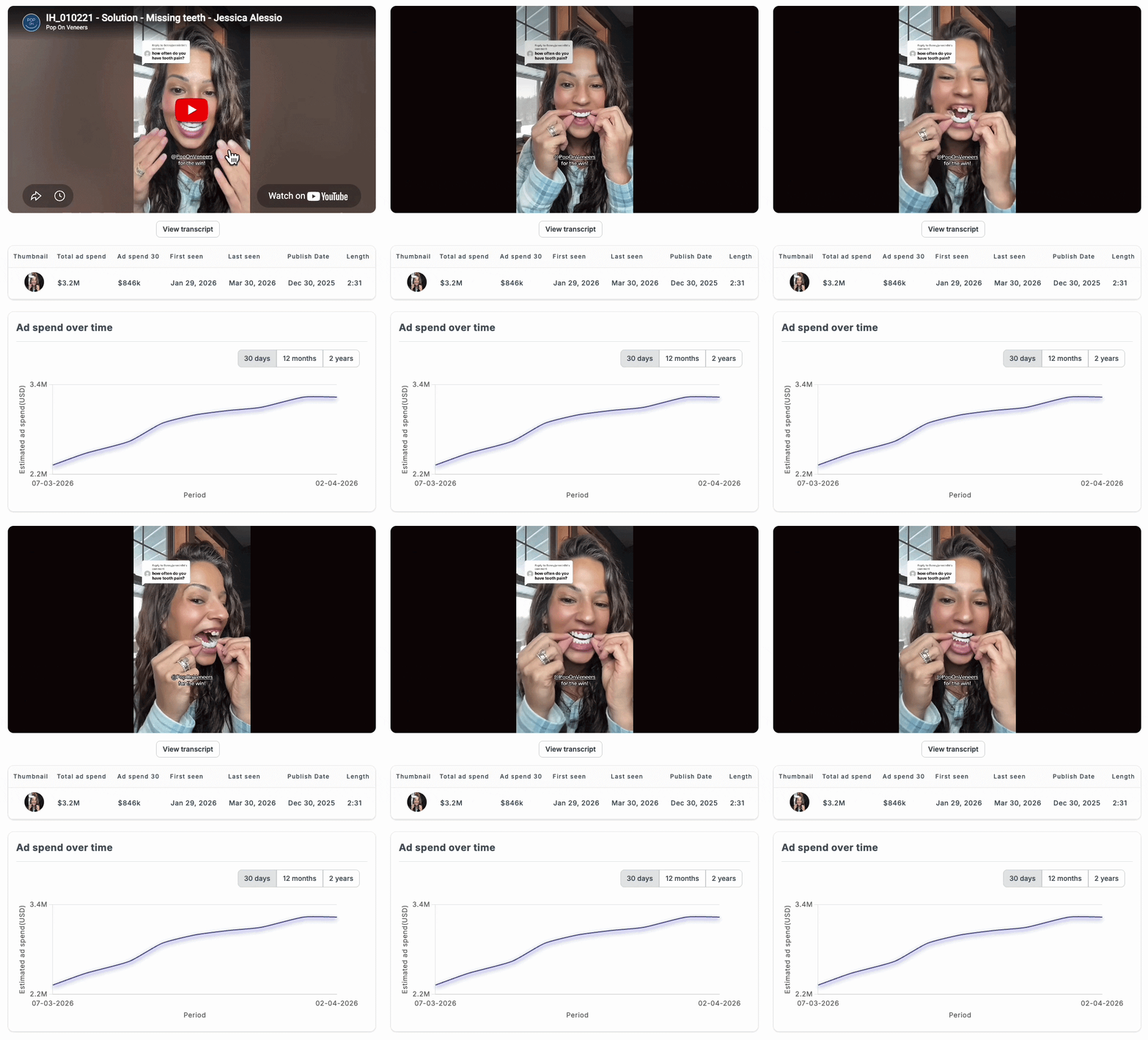
Here are some of this elements this ad consists of:
Opening Hook
"I get this question a lot — how often do I have tooth pain?"
Starting from a community question is a masterclass in social proof by proxy - someone else already cared enough to ask. The viewer inherits that curiosity without being sold to. The immediate personal introduction ("mama of 7, 37 years old") grounds the speaker in relatable, real-life context before a single product claim is made.
 Pain Establishment
"I have many missing teeth on this side. Before I wore these, I would slice my gums open and then infection would happen quicker because I have an open wound in my mouth."
This is graphic, visceral, and completely unscripted-feeling. The detail about slicing gums on chips is the kind of specific lived experience that no copywriter would invent - which is exactly why it's so believable. The viewer with similar dental issues instantly self-identifies and feels genuinely understood for the first time in an ad.
The Honest Hedge
"I can't say I haven't had an infection because I deal with dental health problems... but ever since I started wearing these in the last three to four years, I've had very minimal infections."
This is the most important moment in the ad. Acknowledging imperfection in a product testimonial is counterintuitive but devastatingly effective - it signals that the speaker isn't reading from a script and isn't being paid to say everything is perfect. Every positive claim before and after this moment becomes more credible because of it.
 Product Mechanism
"Where my missing teeth are — see that dark material? They fill that with solid material, so it's not hollow. Makes things sturdy when you're eating."
Showing the inside of the veneer while explaining the structural fill is the kind of live product demonstration that converts skeptics. It's the equivalent of the Qure ad showing the needle size - real-time visual proof that eliminates the "but how does it actually work" objection without a single produced animation.
 The Food List Close
"I eat apples, chips, pizza, chicken, corn, cucumbers. I eat anything. And I'm pain-free."
The food list is deceptively powerful. For someone who can't currently eat most of those foods, each item lands as a specific promise. "I eat anything" is the umbrella claim; the list is the proof. Ending on "pain-free" - repeated twice - anchors the entire testimonial to a single transformative outcome rather than a product feature.
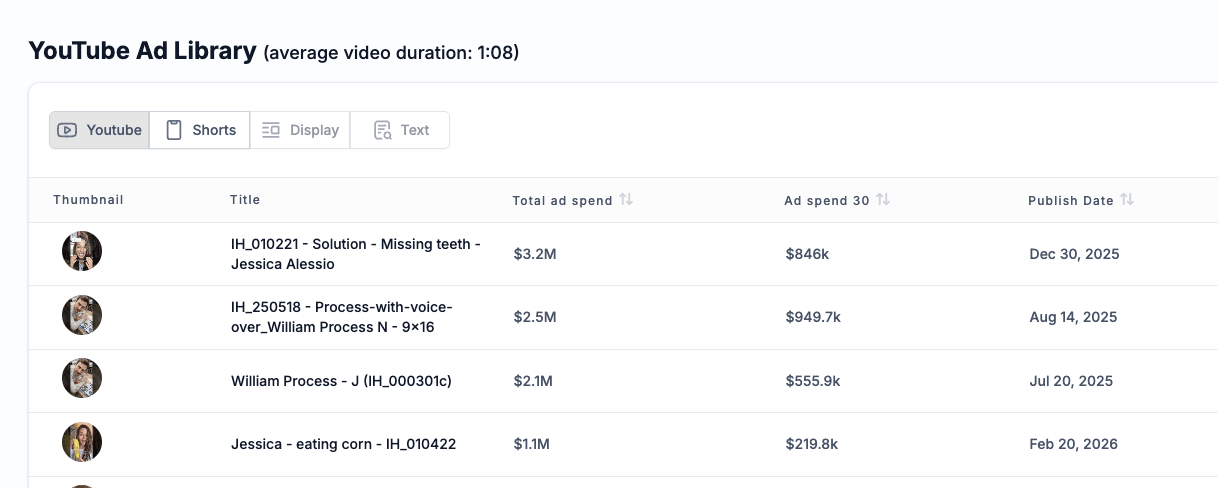
See more incredible, high-spending ads by this advertiser using VidTao:
Takeaways
Admit imperfection to sell harder — "I can't say I haven't had an infection" makes every positive claim in the ad unimpeachable; scripted perfection kills credibility
Reframe the product category entirely — every competitor sells cosmetic veneers; this ad sells pain relief and functional eating, reaching a completely different and underserved buyer
Specificity in the pain scenario is more powerful than specificity in the product — "slicing my gums open on chips" converts better than any feature description
The food list is a proof technique — listing specific foods that were previously impossible makes functional claims tangible and personally relatable
Community Q&A format lowers ad resistance — replying to a real comment makes the viewer feel they're watching a conversation rather than a commercial
Underserved audiences convert with exceptional loyalty — people who have never seen their specific problem reflected in advertising become intensely brand-loyal when a product finally speaks to them
~ update from our friends at Funnel of the Week ~
Air Fryers, ‘Dark Posting’ & Category Creation for a $4B Market
Our friends at Funnel of the Week just released a new funnel breakdown…
… This time it’s a DTC beauty brand using dark posting + smart benefit repositioning to turn a decades-old niche product into a mainstream hit.
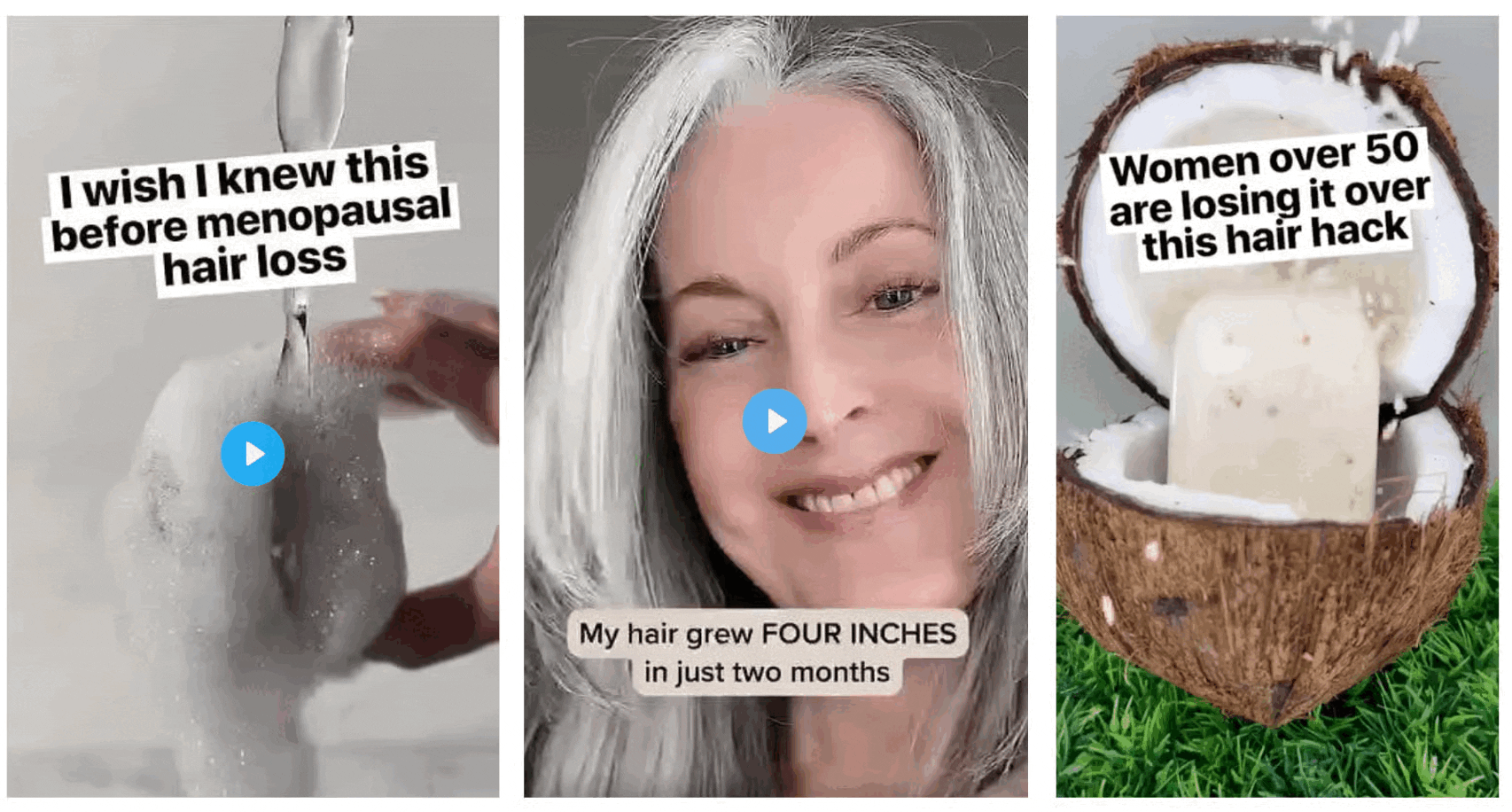
The product? Shampoo bars. The angle? No longer “eco-friendly” - now it’s hair transformation stories like:
“My hair grew 4 inches in 2 months”
“Finally found the solution for my thin, lifeless hair”
And the growth opportunity is huge:
- US shampoo bar market: $4.13B, growing 7.7% annually
- Only 35% of consumers know this category exists
- Only 8% have tried solid shampoo bars
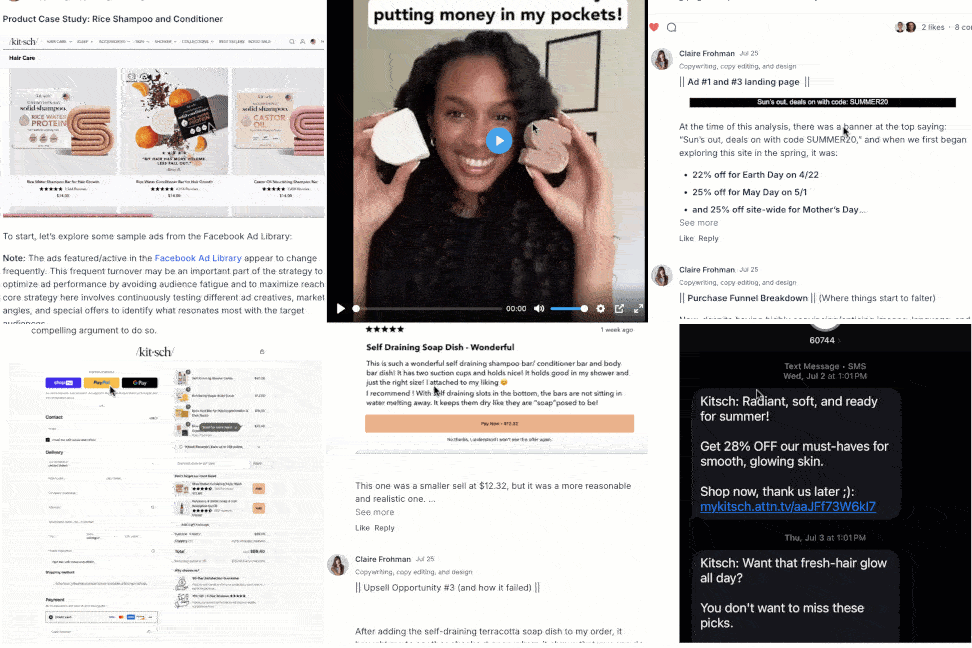
Go here to see more at Funnel of the Week….
Inside this breakdown, you’ll see:
✓ All “dark post” influencer accounts running now - and how they target different demos
✓ Creative strategy that shifts from eco benefits to personal transformation
✓ The awareness stage moves that take someone from “never heard of it” to “ordering today”
✓ How this exact framework has created billion-dollar markets before (electric toothbrushes, plant-based meat, and more)
Pain relief device ad with over $1.3 million in ad spend (Revomadic)
Last ad for today is this pain relief device ad, with ad spend over $1.3M!
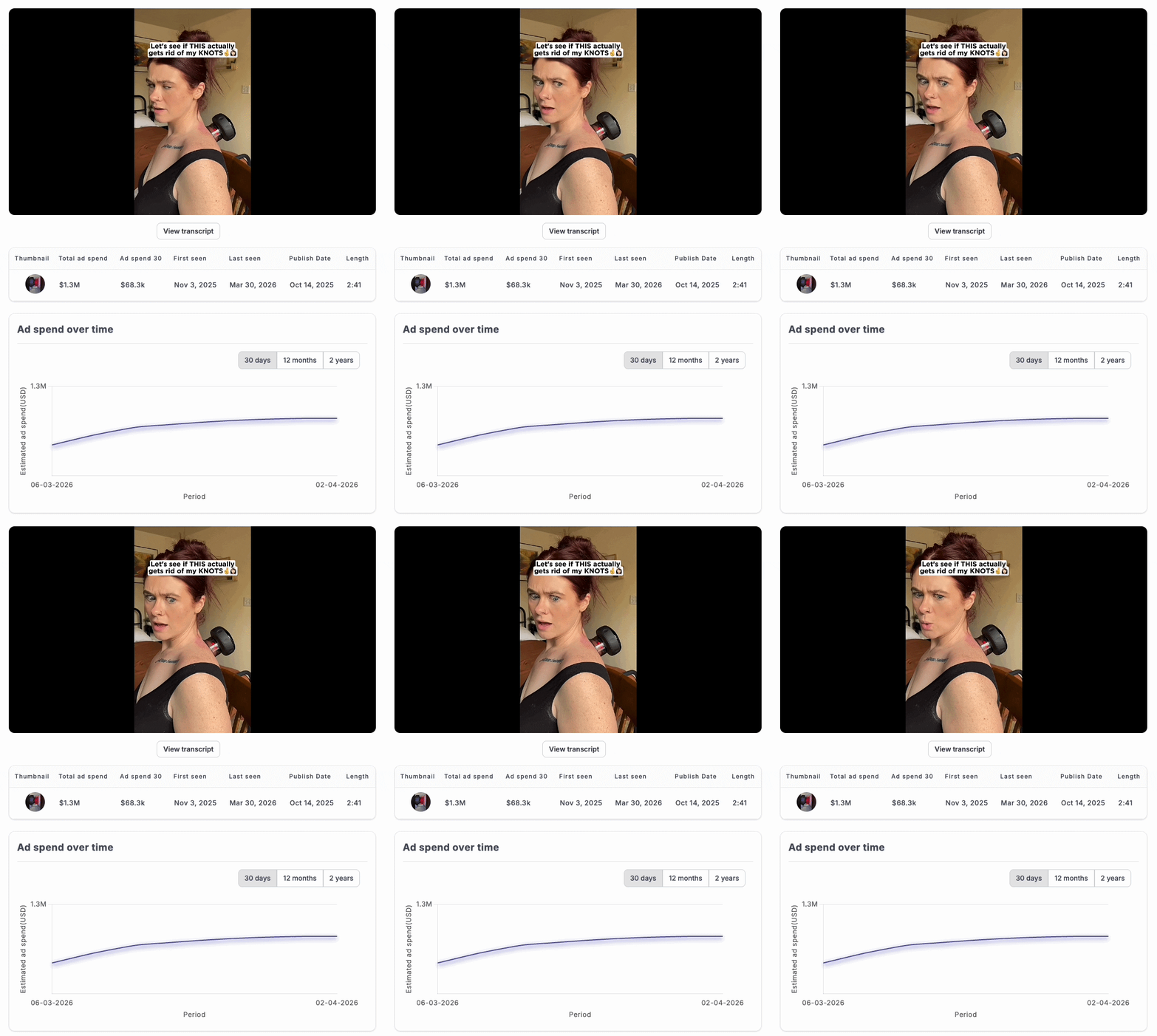
We dissected it, and here are some of the elements this ad consists of: Opening Hook
"Watch what happens when this revolutionary device touches the tense muscle knot for the first time."
"Watch what happens" is a direct behavioral command that bypasses rational resistance - it doesn't ask the viewer to be interested, it tells them to observe. "For the first time" implies the viewer is about to see something unprecedented. The live visual of the device on skin confirms it immediately, making the hook a self-fulfilling promise.
Triple Competitor Takedown
"Not the surface-level pressure from foam rollers or tennis balls. Not the $150 massage where you feel amazing for exactly 2 days and you're right back where you started."
Three competitors dismissed in three sentences, each with a different failure mode. Foam rollers fail at depth. Tennis balls fail at effectiveness. Massage fails at durability - "feel amazing for exactly 2 days" is devastatingly specific. The "$150" price tag on the competitor implicitly anchors Revo as better value before its own price is mentioned.
 The Mechanism Reframe
"Your muscles aren't just tight, they're starved. Starved of fresh blood, starved of oxygen, starved of the space they need to actually heal."
This is the intellectual center of the entire ad. Reframing muscle pain from tightness to starvation is a genuine mechanism shift - it makes every previous solution look like it was solving the wrong problem. The triple repetition of "starved" is rhythmic and emotionally resonant, turning a clinical explanation into something that feels visceral and personal.
The Opposite Principle
"Traditional massage pushes down, compressing tissue even more. But what if we could do the complete opposite?"
"Complete opposite" is a positioning masterstroke. It doesn't just differentiate Revo - it implies that everything before it was directionally wrong. The suction visual makes the mechanism immediately intuitive: if compression is the problem, lifting is the solution. The viewer connects the dots themselves, which is always more persuasive than being told.
 3-in-1 Therapy Stack
Suction → therapeutic heat → red light therapy, each introduced in sequence.
Layering three separate technologies is a classic value stack, but the execution here is unusually smart - each layer is introduced with its own mechanism explanation, making the stack feel scientifically grounded rather than marketing puffery.
"Muscle knots have no choice but to surrender" is exceptional copy - it anthropomorphizes the pain and positions Revo as inevitable victor.
The Value Reframe
"The same combination that would require multiple appointments with different specialists, costing you hundreds of dollars and hours of your time. But here you are getting all three in your living room in 10 minutes."
The specialist comparison does the same work as the Hume Band's "$100,000 cardiac event" anchor - it prices the alternative at maximum cost before revealing the product's price. "In your living room in 10 minutes" is the convenience close that makes the value feel not just financial but logistical.
 The "Buying Three" Nudge
"People aren't just buying one Revo device, they're buying three. One for home, one for the office, and one for their partner."
This is one of the more sophisticated quantity psychology moves in this entire series. It does three things simultaneously: signals overwhelming demand (social proof), provides a ready-made justification for multiple purchases, and introduces the partner angle - expanding the buyer from individual to household without any additional selling required.
 The Freedom Close
"Once you experience what it feels to have your movement back, your sleep back, your confidence back..."
The triple "back" structure is deliberate - it frames the purchase as reclamation rather than acquisition. Pain has taken something; Revo gives it back. "This isn't just another gadget promising temporary relief. This is your freedom from pain that's been controlling your decisions, your mood, your entire quality of life." Elevating the product from gadget to freedom is the emotional peak of the ad.
 Urgency Close
"I need to be honest with you. We're going to sell out today."
"I need to be honest with you" is a trust signal that makes the scarcity claim feel reluctant rather than scripted - the brand is warning you, not pressuring you. The 3-week restock window is specific enough to feel real. Final line "tomorrow's pain doesn't have to be the same as today's" reframes inaction as a choice to keep suffering - clean, emotionally resonant close.
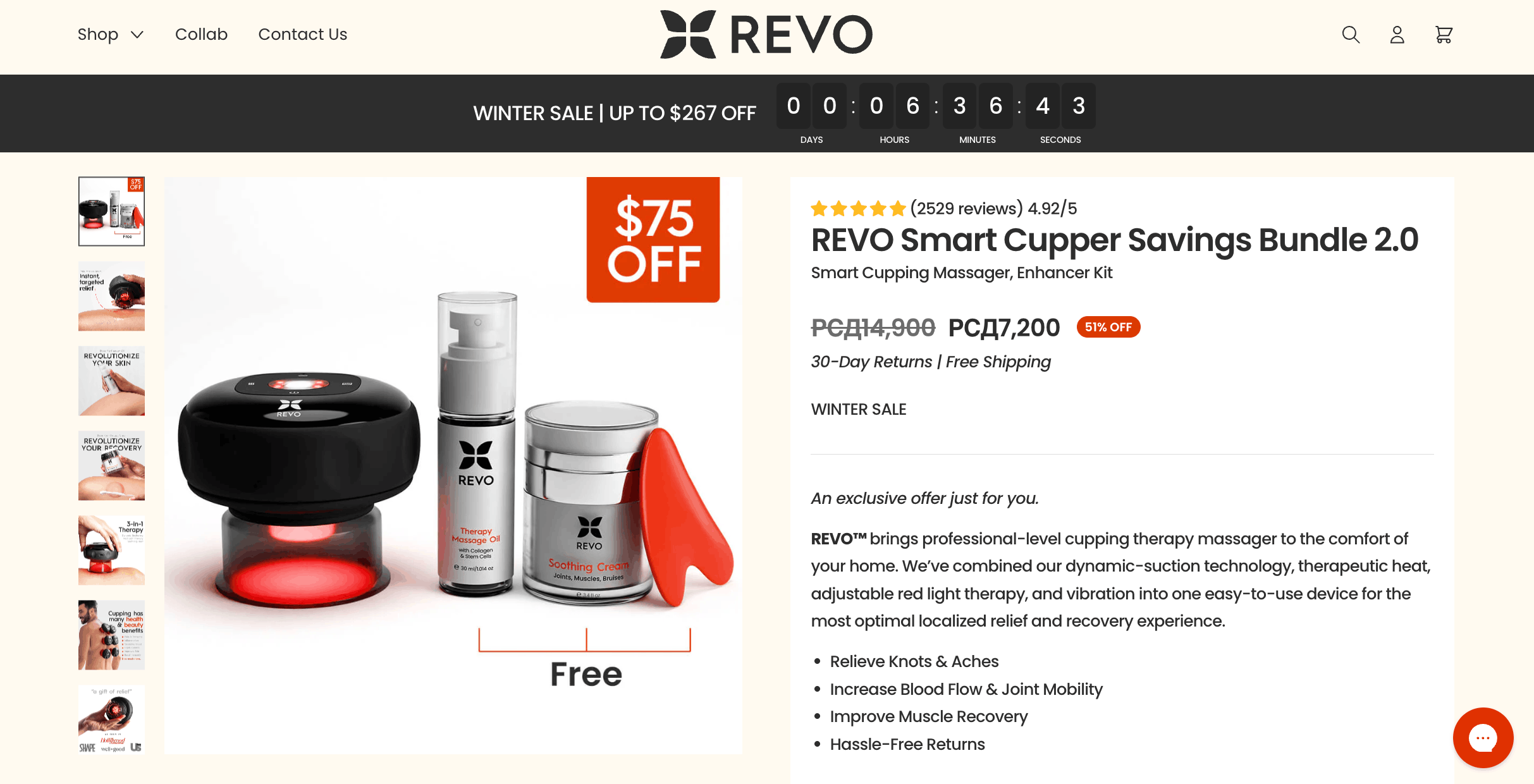
Additionally, ere’s a quick look at this advertiser’s landing page as well:
Want to brainstorm with us on new ways to scale your business with
YouTube Ads (and other performance video platforms)?
Join us for a free YouTube ad brainstorming session here:
With that, we’re all done for this week! 
We hope this week’s selection of high-performing ads has sparked new ideas to test yourself!
Want more insights like these?
Stay tuned for next week’s VidTao 3 Ad Thursday, where we’ll continue breaking down winning strategies from the best YouTube ads in the game!
And btw… If you have questions about YouTube ads?
Go here to schedule a free chat with our friends at Inceptly. Inceptly is a top Direct Response video ad agency, specializing in high-performing YouTube ad creatives & media buying.
Have a great week!
PS - Go here to Claim Your Free Trial of VidTao Premium: Access 34.3 Million YouTube Ads & Their Landing Pages!
PPS - Are you spending $1k/day+ on Paid Ads?  Go here to set up a free YouTube Ad brainstorm chat.