

Want to see some YouTube Shorts ads that are scaling right now, using VidTao ad spy tool?
You’re in luck…
Because today is 2 Shorts Tuesday. Why YouTube Shorts ads?
Because YouTube Shorts ad inventory is only going to keep growing:
5 Reasons Why More Creators Are Choosing YouTube Shorts Instead of TikTok
#1 -  MORE MONEY
YouTube made it easier to earn money with YouTube Shorts in 2024 by letting creators take a cut of ad money from their Shorts—a better deal than TikTok’s confusing payment system.
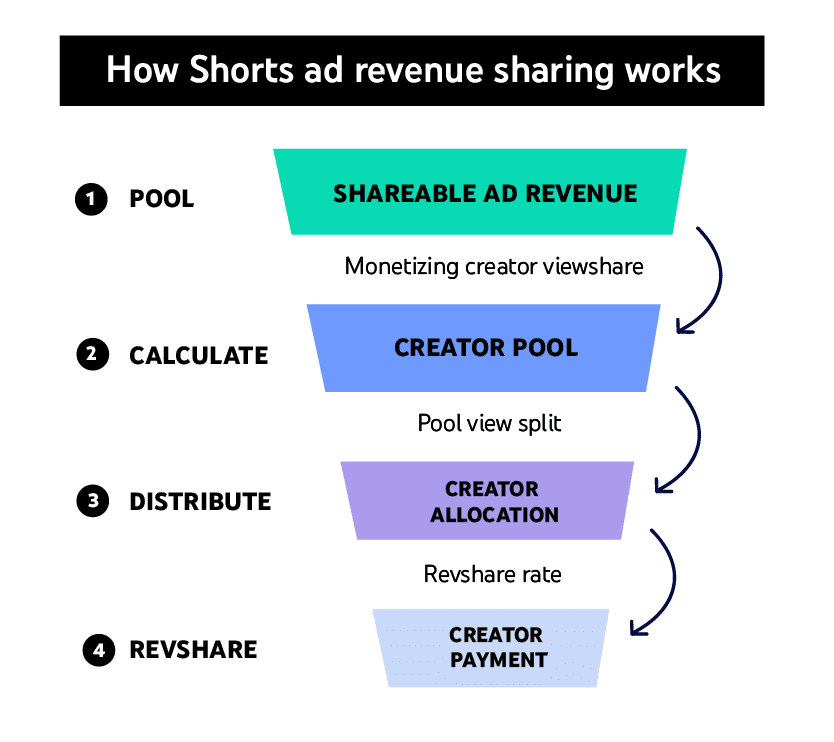
Image source: Google
This works for both short videos and regular YouTube content, making it safer for creators who want steady income.
#2 -  TikTok Ban Rumors/Reality
Rumors (and a quick reality) of a TikTok ban in the U.S. made many creators start posting on YouTube Shorts just in case. YouTube even let Shorts videos be 3 minutes long starting October 2024, copying TikTok’s style while giving creators more flexibility.
YouTube’s Big Advantages
#3 -  Built-in audience
Shorts get boosted by YouTube’s recommendations and trending lists, helping creators grow faster. TikTok doesn’t connect as well to other apps or longer videos.
#4 -  Different viewers
YouTube’s users are often older (25-34) vs. TikTok’s teen-heavy crowd, so creators can reach new fans.
#5 -  Creators Are Fed Up With TikTok
Many say TikTok’s rules change too often, and they’re tired of worrying about bans. YouTube feels more stable, especially with Google’s support for targeting the right audiences. The 3-minute Shorts also let them tell better stories without switching apps.
...And critically, most DTC & Direct Response advertisers are still under-leveraging YouTube Shorts as an ad placement.
(and the upside is huge)
Want to brainstorm with us on new ways to scale your business with YouTube Ads (and other performance video platforms)?
Join us for a free YouTube ad brainstorming session here:
 BOOK A CALL
So, what are some ways you can succeed with YouTube Shorts ads?
Let’s take a closer look at 2 YouTube Shorts ads doing well right now:
Both ads this week spend most of their runtime on the problem, and the product shows up late. Together they've spent almost $5M, and both are still running:
 Ad 1: Clap-to-find phone app, nearly $4M in ad spend
This first ad doesn't explain anything for the first 14 seconds. It just lets you watch a guy lose his phone:

A man in a black hoodie sits on a green ottoman in a school hallway, holding a basketball. On-screen text stays at the top the whole time: "You'll NEVER lose your  phone again ." As he gets up to leave, a close-up shows his phone sliding out of his hoodie pocket onto the seat. He doesn't notice. You do.
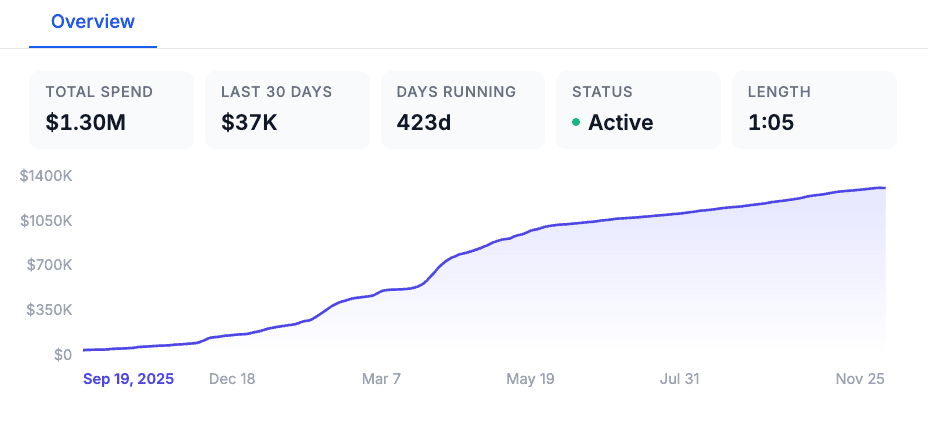
This ad has spent $3.64M on YouTube in 228 days, with $171K in the last 30 days. Most of the spend came between April and June. It held steady through the summer and is picking up again now.
Back in the ad, he gets a few steps away, pats his pockets and starts digging through his backpack. Then the footage goes black and white and a caption appears: "At this moment." The voiceover follows: "99% of people would start sweating and panic."
Then the fix: "but thanks to this app all you have to do is clap." He claps once. The video cuts to the phone lighting up and ringing, stuck between the ottoman and the wall, with the caption "and your phone will ring to end your misery." A bell sound plays. The ad closes on the app's settings screen while the voiceover says "Download it now while it's still…"
What this ad really is: a 14-second comedy skit with a 3-second product demo at the end.
Why this ad works:
• The viewer sees the problem happen before the character does. We watch the phone fall out of his pocket, and he doesn't. That gap keeps people watching to see when he'll notice. By the time he starts searching, the viewer is already invested in him finding it.
• "At this moment" turns a small annoyance into a meme. The black-and-white freeze is the familiar "at this moment, he knew" internet meme. It turns a lost phone into a moment of panic, and "99% of people would start sweating" puts a name to the feeling everyone has had.
• The whole product is one action anyone can picture. There's nothing to install or set up on screen. He claps and the phone rings, in under three seconds. The viewer never has to believe it's easy, because they watch it happen.
• The promise is on screen from start to finish. "You'll NEVER lose your phone again" stays at the top for the whole ad. Someone watching with the sound off still gets the offer, and the all-caps "NEVER" makes the strongest claim in the ad without the voiceover ever saying it.
• The settings screen at the end shows it's a real app. Ending on the actual app, with toggles and options visible, answers "is this a gimmick?" as the viewer is about to tap download. Since it's an app download, the ask is small, and the screen fills the last few seconds.
Creative beats to swipe:
- Act out the problem without talking. Let the viewer spot it before the character does.
- Keep your boldest promise on screen as text for the whole ad.
- Use a familiar meme format at the moment of panic.
- Show the fix as one physical action that pays off on screen within seconds.
- End on the product's own interface while you say the call to action.
 "Spy" on 42M YouTube Ads
(plus Landing Pages)!
Unlock proven strategies for success with the VidTao Premium YouTube Ad Library. Get instant access to your FREE VidTao trial today 
 Claim Your FREE VidTao Trial Now!
Take the guesswork out of YouTube ads – start scaling smarter.
 Ad 2: The Pillow Home (Cozyrest Neck Pillow, side-sleeper pain)
This next one opens on a footage that might seem kind of random:

Then the screen switches to his phone. First a BestMoney "Multi Car Insurance Plan" page with 78/month full coverage split across two cars (35.30 + $42.70), then the quiz itself ("What's your car's make?") with a grid of car logos and his thumb tapping through.
It cuts back to him for the "we're done getting ripped off" close. Two disclaimers show up at the bottom: "The individual in this video is a paid actor and the content is not based on actual customers testimonials," and "Bestmoney.com does not feature all providers on the market."
A man in black gloves is working a metal scraping tool down a patient's bare back, like you'd see in a sports therapy clinic. The caption over it reads: "You need to change your pillow."
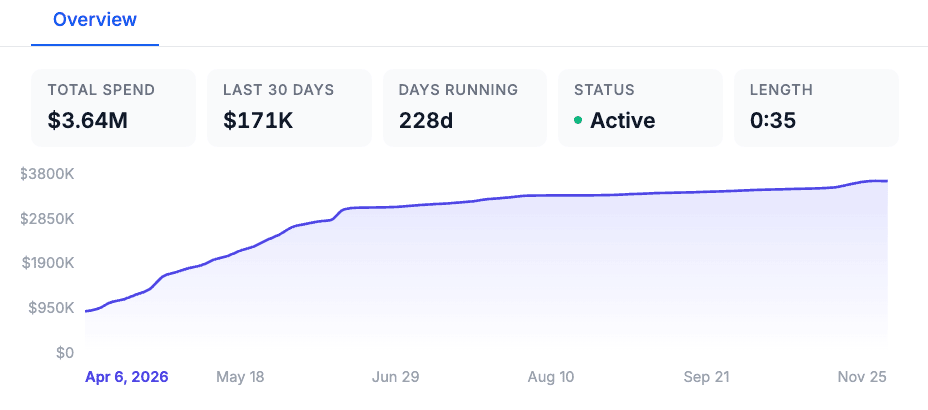
This ad has spent $1.30M on YouTube, with $37K in the last 30 days. It's been running for 423 days and is still active. Spend picked up sharply in spring 2026 and has kept climbing at a steady rate since.
Two seconds in, it cuts to a TikTok-style comment reply: "What if you sleep on your side." A hand squishes an ordinary pillow flat. Then a woman in a sleep mask lies on her side on that same pillow while a voiceover runs through everything that's wrong with her setup.
What this ad really is: a pillow pitch that holds the product back until the viewer has diagnosed themselves. The voiceover lists three mechanisms: your neck is "just floating," your shoulder gets "compressed," and a pillow that's too high or too low throws your spine out of alignment. An illustrated spine diagram with red pain dots backs it up. Then it adds a fourth problem nobody asked about: if you sleep on a soft mattress, "your bed will sink in more around your hip."
Only at the 0:37 mark do we see the product. It's a contoured memory foam pillow, and a small blue ball dropped onto it settles into the dip in the center. The close is a classic offer: "over 40% off with free shipping," free returns, "linked it down below." The brand name is never spoken.
Why this ad works:
• A 14-month run says this ad gets past creative fatigue. Most Shorts ads burn out in weeks. This one is still spending about $37K a month after 423 days. That usually means the hook isn't a novelty that wears off: it's a problem the audience keeps having, and new side sleepers with sore necks keep arriving.
• The opening clip borrows authority without making a claim. A gloved practitioner working on someone's back says "expert" before a single word is spoken. The caption "You need to change your pillow" lands as a professional's verdict. The ad never says who he is, and it doesn't need to.
• A five-body-part checklist casts the widest net possible. "Your neck, your upper back, your shoulder, your lower back, or your hip" is said three times in 65 seconds. Almost every side sleeper has at least one of those. Repeating the full list means each viewer hears their own pain at least once.
• Each pain gets its own mechanism, so the pillow feels like the obvious answer. Floating neck, compressed shoulder, misaligned spine. By the time the product appears, the viewer already knows the three features it needs. The neck support, ear hole and arm space then land as solutions they were waiting for, not as a feature list.
• Small, slightly gross details make it believable. Flip it over "if the pillow is too high for you." Take off the case "if you get sweat or ear wax on it", and at 0:55 we watch someone peel it off. Nobody writes "ear wax" into a brand script. It reads like a real owner talking, and it answers two objections (fit and hygiene) in two sentences.
Creative beats to swipe:
- Open on a clip of a practitioner at work, with your verdict as the caption.
- Use a comment-reply bubble to narrow down to your exact buyer ("What if you sleep on your side").
- Name every body part or symptom your product touches, and repeat the full list.
- Give each symptom its own one-line mechanism before showing the product.
- Handle fit and hygiene objections with specific, unglamorous details.
- Build around a problem your buyers have every night, not one tied to a trend or season, so the ad keeps finding new buyers for over a year.
"Spy" on 42M YouTube Ads
(plus Landing Pages)!
Unlock proven strategies for success with the VidTao Premium YouTube Ad Library. Get instant access to your FREE VidTao trial today
Take the guesswork out of YouTube ads – start scaling smarter.
What these two have in common
Neither ad says its brand name out loud. The app is just "this app," and the pillow is "these pillows." Both spend more than half their runtime on the problem. The pillow first appears at 0:37 of 1:05, and the clap comes at 0:19 of 0:35. And both pick a problem that comes up constantly: a lost phone, a sore neck every morning. That's likely why one of them is past $3.6M and the other has run for over a year. The takeaway: if your product fixes something people deal with every day, spend your seconds making them feel the problem, then show the fix fast.
Want to brainstorm with us on new ways to scale your business with YouTube Ads (and other performance video platforms)?
Join us for a free YouTube ad brainstorming session here:
That's all for this week! 
We hope this week’s selection of high-performing YouTube Shorts ads has sparked new ideas to test yourself!
Want more insights like these?
Stay tuned for next week’s VidTao 2 Shorts Tuesday…
…where we’ll continue breaking down winning YouTube Shorts Ads you can break down + model for your own creatives & campaigns.