

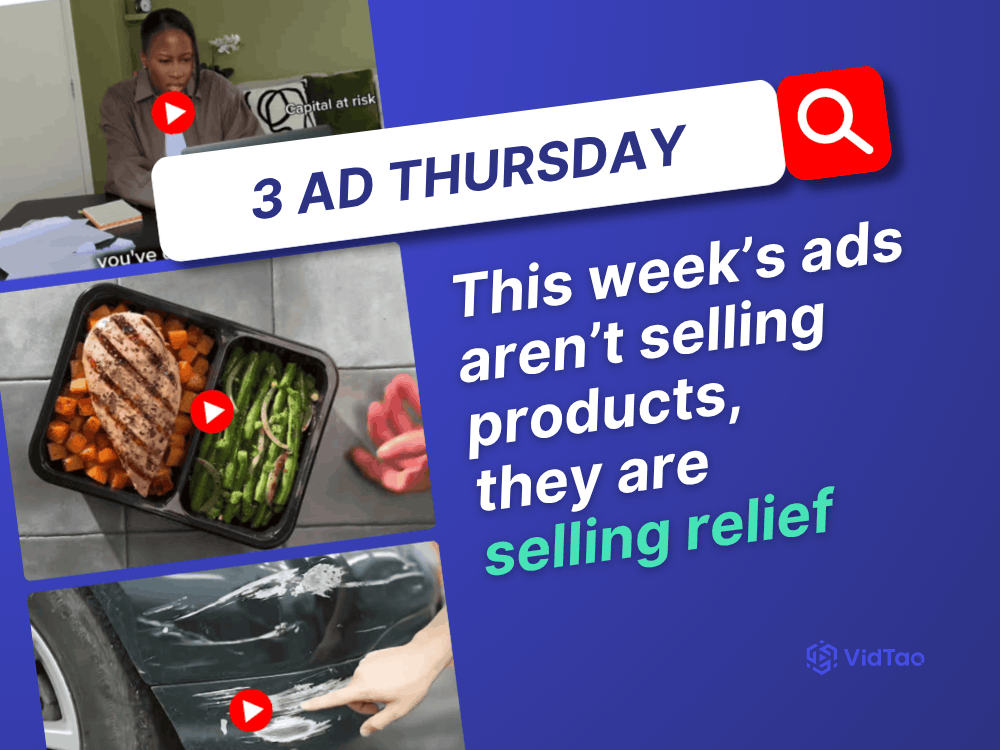
Welcome to, or welcome back to this week’s VidTao 3 Ad Thursday, where each week we’ll be diving into our VidTao ad intelligence tool to uncover 3 high-performing YouTube ads driving results!
This week we’ve got three high-performing YouTube ads for you to check out & model, including:
 Pension Bee ad with over $3M in ad spend…
 Car scratch remover cloth ad with nearly $7M in ad spend…
 Chef-made prepared meal ad with over $7M in ad spend…
Want to brainstorm with us on new ways to scale your business with YouTube Ads (and other performance video platforms)?
Join us for a free YouTube ad brainstorming session here:
 BOOK A CALL
Let's dive right in and take a closer look at this week's YouTube ad standouts and discover what makes them so successful.
Pension Bee ad with over $3M in ad spend
Let’s get right into watching our first ad pick for this week:

Let’s dissect it together: Hook “Don’t you just hate it when you’ve got random pensions floating around and zero clue what’s going on with any of them?”
The hook is a shared-annoyance question rather than a bold claim. Opening visually on the presenter tearing open envelopes at a cluttered desk shows the problem before the product appears, so the viewer recognizes their own situation within seconds. The “you” framing and the casual “don’t you just hate it” tone signal a friend venting, not a financial institution pitching.
 The Confession “Yep. This was me. Guilty. I had a couple of old pensions from my past jobs.”
Three short beats of self-identification (“Yep. This was me. Guilty.”) disarm the shame that often surrounds money admin. The modest scale of the problem (“a couple of old pensions”) also keeps the situation relatable instead of dramatic, so viewers with only two or three old pots still see themselves in it.
 The Mess “Different providers, different logins, different passwords, random bits of paperwork. It was literally all a big mess.”
The repeated “different” builds a rhythm that mimics the feeling of accumulating hassle. Listing the specific fragments (logins, passwords, paperwork) turns a vague sense of disorganization into a checklist the viewer can mentally tick off, making the pain feel real and solvable.
The Discovery “Then, I found PensionBee. And I’m not joking. They made it so easy. I just signed up, gave them a few details, and boom! They were able to combine my old pensions together for me.”
The product enters as a discovery rather than a pitch. “I’m not joking” pre-empts the skepticism a viewer might feel about anything promising “easy” in finance. The screen recording of the sign-up page, with its short form (name, email, password), backs up the “few details” claim visually, and the on-screen trust markers (customer count, Trustpilot rating, award badge) add credibility without a single spoken claim.
 The Payoff “Now I’ve got everything in one place, on my phone. No stress, no endless paperwork, and no more hunting for passwords.”
The three “no” statements each reverse one of the pains listed earlier, so the resolution maps directly onto the problem. The phone-in-hand visual of a welcome screen addressing her by name makes the outcome feel concrete and personal.
 The Transformation “I literally feel lighter. And I’ve gone from confused and overwhelmed to confident and in control. When your pension’s in a good place, you’re in a good place, too.”
This is the emotional peak, and it deliberately skips any mention of money. The final line ties pension tidiness to personal wellbeing, which gives a mundane admin task an emotional payoff. The relaxed, smiling sofa shot reinforces the feeling the copy describes.
 Close “Combine now with PensionBee.”
The CTA is a short, single-action instruction that reuses the product’s core verb (“combine”), so the action and the benefit are the same word. There’s no urgency or discount, which suits a considered financial decision.
 Why It Works
- Naming a problem people avoid thinking about creates instant recognition: Forgotten pensions are the kind of issue viewers push to the back of their minds. Surfacing it casually, with relatable visuals, prompts a “that’s me” reaction without making the viewer feel judged.
- Confession-first storytelling lowers defensiveness: Opening with “Guilty” positions the presenter as a peer who made the same mistake, so the advice feels like a friend’s tip instead of a financial product’s sales pitch.
- Mirroring each pain with its reversal makes the solution feel complete: Every irritant named early (logins, passwords, paperwork) gets a matching “no more” in the payoff, so the viewer sees their whole problem resolved instead of just one part of it.
 "Spy" on 42M YouTube Ads
(plus Landing Pages)!
Unlock proven strategies for success with the VidTao Premium YouTube Ad Library. Get instant access to your FREE VidTao trial today 
 Claim Your FREE VidTao Trial Now!
Take the guesswork out of YouTube ads – start scaling smarter.
Car scratch remover cloth ad with nearly $7M in ad spend
Our next ad is for a cloth that ‘magically’ removes scratches from the cars, check it out:

These are the elements that make this ad work:
 Hook “See this scratch? Auto shops will easily charge you two grand.”
Opening on a gouged, scuffed bumper with a bold on-screen caption means the viewer is looking at the problem while hearing its price. The question “See this scratch?” works as a direct address, and anyone who has ever owned a scuffed car recognizes the exact feeling. The price is named before the product, so the product arrives as the answer to a cost the viewer is already wincing at.
 The Demo “Rub it for about 30 seconds, then just walk away and let it sit like 30 minutes. Let the magic happen. Come back with a little water, then wipe it off, and boom, it’s brand new again.”
The instructions are casual and almost lazy (“just walk away”), which sells ease as much as the result. The timing is specific (30 seconds, 30 minutes) without being burdensome, so the process feels real but undemanding. The word “magic” gives the viewer permission to accept a result they can’t fully explain.
 Founder Credibility “Hey, I’m Dave. I used to run a body shop for 15 years, and now I’m the founder of CarCloth.”
The introduction arrives about 25 seconds in, after the demo has already earned attention. Pairing a specific number of years (15) with a recognizable trade makes him an insider with a reason to know the real costs, and the shop setting behind him supports the claim visually. He also holds the cloth in hand, so the credential and the product appear in the same frame.
 The Cost Teardown “I used to feel bad for my customers... That sander over there, $19,000. Those paint guns, the mixing station, another $35,000 easy.”
This is the ad’s most strategic beat. Instead of attacking auto shops as greedy, he sympathizes with his own past customers and explains the high price as a function of expensive equipment (“not because I wanted to, but because that’s just what it costs”). That keeps him likable and makes the old way seem like an outdated system rather than a scam. The line “you don’t need any of this” then dismisses the entire cost structure at once.
 The Origin Story “I first saw it at a tech expo in Germany. These engineers were showing off this aerospace polymer... I was like, ‘Why not on car paint?’”
The story supplies a mechanism without needing a scientific explanation: an aerospace-grade material, self-healing properties, two years of university development. The question “Why not on car paint?” casts the founder as an ordinary person with a good idea, not a corporation, and the expo and rocket visuals give the claim cinematic weight.
 Before/After Proof (split-screen shots of blue and red car panels, scratched on the left, smooth on the right)
Labeled BEFORE and AFTER panels across different paint colors back up the verbal claim that it works on any car. The line “doesn’t matter what color your car is, black, white, or even premium silver” preempts the most likely objection (will it work on mine?) and the visuals show it in multiple colors.
 Close “We even back it with a 30-day money-back guarantee. Right now, we’re running a 60% founders discount for the holiday... Ever since we started the sale, they’ve been selling out quick, so grab yours before they’re gone.”
The close stacks three levers in sequence: risk reversal (guarantee), a discount tied to a seasonal reason (holiday), and stock scarcity (“selling out quick”). The end card repeats the offer visually with the product box, a gold 30-day badge, and “60% OFF Today.”
Why It Works
- Naming the expensive alternative first makes a cheap product feel like a windfall: Opening with “two grand” sets the reference price in the viewer’s mind, so anything below it feels like savings before the actual price is even mentioned.
- An insider explaining his own industry’s costs is more persuasive than an outsider criticizing it: The ex-body-shop owner sympathizes with the old pricing while dismantling it, which avoids the defensiveness a “shops are ripping you off” message would trigger.
- A short, visible process removes the biggest objection to DIY repairs: The viewer’s fear is usually “I’ll make it worse.” Showing a simple rub-wait-wipe routine on camera, plus “don’t worry about messing up your paint,” addresses it directly.
"Spy" on 42M YouTube Ads
(plus Landing Pages)!
Unlock proven strategies for success with the VidTao Premium YouTube Ad Library. Get instant access to your FREE VidTao trial today
Take the guesswork out of YouTube ads – start scaling smarter.
Chef-made prepared meal ad with over $7M in ad spend
Last but not least, an ad for pre-made, chef-made healthy meals:

Let’s see why this ad works so well:
 Hook “Want to lose weight without losing muscle? Factor got me there.”
The opening question and the answer arrive in two quick sentences, so the product is named within seconds. The first shots are close-ups of a plated meal (salmon over a corn and chickpea salsa with roasted potatoes), which lead with appetite appeal before any claim is made. For a food product, showing that it looks good first is the strongest proof of taste.
 The Frustration “I was tired of all the cutting and bulking cycles. So, instead of trying to out-diet myself, I swapped one or two meals a day for Factor.”
The phrase “out-diet myself” casts willpower-based dieting as a losing game, which puts the viewer’s past struggles on the plan and not on them. The solution follows immediately and is framed as a small change, which keeps the pivot believable.
 The Product Case “They’re chef-made, so they’re actually delicious and satisfying. But, each meal’s also portion-controlled and full of protein, so my calories stay in check without me losing muscle.”
The word “actually” signals the presenter is addressing a skepticism the viewer already holds about prepared meals. The sentence moves from taste to portions to protein to muscle retention, so each feature leads to the benefit stated in the hook. Visually, the presenter holding a forkful of food toward the camera backs up the “delicious” claim in a way a voiceover couldn’t.
 The Result “I’m down 8 lb in 8 weeks, all without feeling miserable or settling for bland, boring meal prep that took hours to make myself.”
A specific number over a specific timeframe turns a vague promise into something measurable, and the pace (about a pound a week) sounds realistic, not miraculous. The sentence also contains the ad’s main contrast: results without misery, and convenience without compromising on flavor.
 The Convenience Contrast “This took me 2 minutes. No planning or cooking, so I’m not burning out. I’m actually staying consistent.”
Placing “2 minutes” directly after “hours” makes the time savings land as a punchline. The line about consistency also reframes the product’s value: it isn’t just easier, it’s what makes the results sustainable.
 Close “If you care about performance and efficiency, this is the smarter way to lose weight.”
The final line addresses an identity (“if you care about performance and efficiency”) instead of a deprivation or a discount, which flatters the viewer into seeing the purchase as a smart optimization. The offer itself appears only visually in the closing seconds: “50% off your first box + free breakfast for 1 year,” shown over an opened delivery box, with the fine print noting it applies to new subscribers only.
Why It Works
- A tightly specific goal in the hook filters for a motivated audience: “Lose weight without losing muscle” speaks directly to people who already train and care about body composition, so the viewers who stay are the ones most likely to value the product.
- Framing the product as a swap shrinks the perceived commitment: Replacing one or two meals is a small, concrete action, which makes trying a subscription feel like a low-risk experiment and not a lifestyle overhaul.
- Answering the two classic objections at once removes the usual reasons to hesitate: Prepared-meal skeptics typically worry about taste and about whether the food fits their goals. Addressing both in a single sentence, with a plated meal on screen as proof, closes both gaps quickly.
Want to brainstorm with us on new ways to scale your business with YouTube Ads (and other performance video platforms)?
Join us for a free YouTube ad brainstorming session here:
We're all done for this week!
We hope this week’s selection of high-performing ads has sparked new ideas to test yourself!
Want more insights like these?
Stay tuned for next week’s VidTao 3 Ad Thursday, where we’ll continue breaking down winning strategies from the best YouTube ads in the game!