

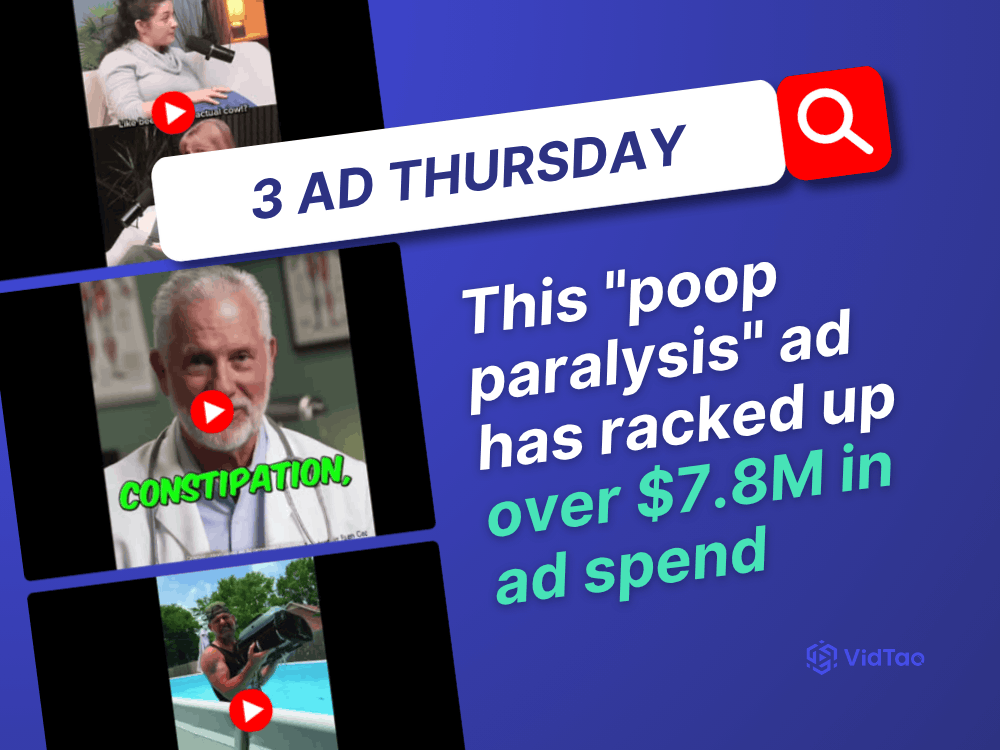
Welcome to, or welcome back to this week’s VidTao 3 Ad Thursday, where each week we’ll be diving into our VidTao ad intelligence tool to uncover 3 high-performing YouTube ads driving results!
This week we’ve got three high-performing YouTube ads for you to check out & model, including:
 A gut health ad that renames constipation, with $7.84M in ad spend
 A robotic pool cleaner review from a 35-year pool pro, with nearly $200k in ad spend
 A podcast-style beef thyroid supplement ad, with $115K in ad spend
Want to brainstorm with us on new ways to scale your business with YouTube Ads (and other performance
video platforms)?
Join us for a free YouTube ad brainstorming session here:
 BOOK A CALL
Let's dive right in and take a closer look at this week's YouTube ad standouts and discover what makes them so successful.
The ad that renamed constipation: "poop paralysis" with $7.84M in ad spend

An all-AI ad (AI doctor, AI patient, AI everything) that ran for 70 days and spent roughly $7.84M. It never reveals its product. The only goal is to get you to click and watch a second video.
 Hook
"If you sit on the toilet, bear down, and barely anything comes out, you don't have constipation, you have poop paralysis."
The scenario is so specific it feels like the speaker has been in your bathroom. Then the ad tells you that you've been calling your problem by the wrong name, and "the difference between the two is everything" opens a loop you can't close without watching. It also promises the payoff immediately ("when you do this for 7 seconds, it all comes out effortlessly") and withholds the method for the rest of the runtime.
 The mechanism
"Scientists call them peristaltic muscles, but I just call them your poop muscles."
A 3D colon animation gives the explanation something to look at, and the "ocean wave" metaphor makes a technical process easy to picture. The narrator swaps the clinical term for a blunt one, then uses it again and again, so the ad ends up with its own vocabulary.
 The unnamed villain
"There's a food sitting in nearly every kitchen in America right now that quietly paralyzes poop muscles."
The food is never named, so the viewer mentally searches their own pantry. "Quietly" and "over enough years" also explain why you never noticed, which makes the claim hard to disprove from your own experience.
 The escalation
"Poop builds up until you've got 10, 15, even 20 lb of stuck stool."
The ad links symptoms you already have (bloating after meals, straining, feeling "like absolute garbage") to a worst case that includes surgery. Then it adds a clock: the longer the muscles stay "paralyzed," the worse everything gets. A mild daily annoyance starts to look like something that can't wait.
 The competition teardown
"Fiber just adds more bulk to already stuck poop, which is like adding more cars to a traffic jam."
Every common remedy gets one vivid reason it fails: fiber is a traffic jam, laxatives make muscles weaker, water assumes the poop is dry, and magnesium, castor oil, and prune juice "target the poop, not the muscles." The viewer's whole medicine cabinet gets ruled out before the fix is offered.
 The authority reveal
"She was the director of the GI motility center at Mount Sinai and has performed thousands of colonoscopies."
A name, a specialty, an institution, and a number arrive only after the problem is fully established. By then the viewer wants a credible person to hand the problem to, and the ad supplies one.
 The close
"Click below now to watch. No email required or anything like that."
The ask is to watch, not to buy, and the "no email" line removes the usual friction. The visuals tease the method with a pink drink next to bottles of apple cider vinegar and cranberry juice, but the script never says what it is.
 Important takeaways
 Rename the problem, don't just describe it. A new name makes every previous solution look like it was aimed at the wrong thing.
 Explain why everything else failed before you offer the fix. Ruling out alternatives in advance turns past disappointments into evidence that the viewer needs something new.
 Give your mechanism its own vocabulary. "Poop muscles" is easier to repeat, remember, and believe than "peristaltic muscles."
 Sell the click, not the method. Three open loops (the 7 seconds, the food, the technique) keep people watching until the CTA is the only way to resolve them.
 Hold the credentials until the problem is established. Authority lands harder when the viewer already wants someone to trust.
 Make the first ask tiny. "Watch a short video, no email" is far easier to say yes to than any purchase.
 Worth flagging: "Poop paralysis" is a coined term, not a recognized diagnosis. The claims that laxatives cause the problem and that fiber and water don't help go well beyond what mainstream gastroenterology supports, and the "10 to 20 lb of stuck stool" figure has no source. The on-screen doctor is an AI-generated older man while the script credits a different named physician, with only tiny disclaimers on screen. Study the structure, not the claims.
 "Spy" on 42M YouTube Ads
(plus Landing Pages)!
Unlock proven strategies for success with the VidTao Premium YouTube Ad Library. Get instant access to your FREE VidTao trial today 
 Claim Your FREE VidTao Trial Now!
Take the guesswork out of YouTube ads – start scaling smarter.
The pool pro who tested it out loud: a robotic cleaner with nearly $200k in ad spend

A review-style ad on the brand's own channel, fronted by a self-described 35-year pool veteran. It opens loud, plays like a live test, and closes with a price argument.
 Hook
"My name is Cash. 35 years in the pool business."
He slams the cleaner against the pool edge while belting a hit Beyonce song, with a caption over the footage reading "Review of the WYBOT robotic pool cleaner." It's pure pattern interrupt, and the rough handling doubles as a durability signal before any claim is made.
 The skeptic setup
"For this price, it's got way too many features to be true."
He starts from the viewer's own doubt, which makes everything after it feel like a fair trial. A skeptical viewer is much more willing to watch a test than to hear a claim.
 The test questions
"Can it clean the water lines? Can it clean the walls? Can it clean the floor? We're going to find out."
Three questions create a scorecard the viewer can follow. Each one gets answered on camera, in order, which turns a feature list into a story with suspense.
The live run
"Let's make sure it wasn't just a fluke."
The commentary plays like a sports broadcast, and then he re-checks his own result while the camera keeps rolling. That one move makes the demo feel honest instead of staged. Visible leaves and fine debris on the pool floor give the viewer a clear before-and-after.
 The spec, translated
"A lot of these cleaners have multiple ports, which creates little cyclones, shoots the dust out."
He introduces a design detail (single port) and immediately explains the problem it solves in plain language. The tracks get the same treatment: they handle stairs, benches, and sun ledges, which widens who the product is for. And the waterline feature is tied to a chore the audience already hates: "that you usually have to get a net and get out manually."
 The basket reveal
"Look at all the debris. That was just in that one pass."
He opens the basket on a patio table, packed with debris, and the claim becomes something you can see. "Just in that one pass" says "powerful motor" without a single number.
 The price reframe
"Instead of buying these little $150, $200 cleaners that never get the job done, spend the extra money."
The close compares the product with the cheaper alternative the viewer has probably been burned by, so the higher price reads as the smarter buy. The CTA is one plain instruction, with no countdown or discount.
Important takeaways
Open with the viewer's doubt. Saying "too many features to be true" first earns you permission to run a demo.
Ask the questions before you answer them. Three test questions up front turn a spec sheet into a scorecard with built-in suspense.
Re-test on camera. Checking your own result ("make sure it wasn't a fluke") builds more trust than any amount of enthusiasm.
Translate every spec into a problem it solves. "Single port" means nothing until you explain the cyclone problem it avoids.
Show the evidence in a container. A full basket on a table is a proof the viewer can judge for themselves.
Compare against the cheap alternative. Naming the $150 cleaners that "never get the job done" makes the higher price feel like a correction.
"Spy" on 42M YouTube Ads
(plus Landing Pages)!
Unlock proven strategies for success with the VidTao Premium YouTube Ad Library. Get instant access to your FREE VidTao trial today
Take the guesswork out of YouTube ads – start scaling smarter.
The supplement ad that made its weird name the hook: beef thyroid with $115K in ad spend

A staged podcast clip: two women on couches with studio mics, split-screen, with inserts illustrating what the guest is describing. It's a smaller, shorter run (51 days, about $115K), but the structure is worth studying.
Hook
"Sorry. Beef thyroid? Like beef from an actual cow?"
The host voices the viewer's reaction to the product name in the very first second, with "BEEF THYROID!?" captioned over the split screen. Instead of explaining the strangeness away, the ad leans into it, and the odd name becomes the scroll-stopper.
 The definition and the "why beef"
"It's what traditional cultures use for thyroid support."
The answer stacks three reasons in a row: biological similarity to humans, nutrient density, and tradition. The bottle appears as an insert over a flower background as it's named, so the viewer sees the product at the moment it's defined.
 The prescription question
"Wait, so is it like a prescription thyroid medication?"
This is the exchange that matters most. A thyroid patient's first question gets asked and answered ("not exactly... it's a whole food supplement"), and the product is positioned next to prescription options without being one. Framing synthetic options as "isolated hormones" makes the supplement sound more complete.
 The proof layer
"I feel like a new person."
The guest is both explainer and user, so her enthusiasm doubles as a testimonial. She then widens it to "all the reviews" (better energy, improved lab numbers, weight management, mood) without naming a single one. A barbell scene is inserted at "improved lab numbers," which turns an abstract claim into an image of strength.
 The honest-sounding timeline
"It's not a quick fix. It's long-term nourishment for your health."
Telling viewers to expect 2 to 3 weeks for subtle changes and 2 to 3 months for full benefits runs against the instant-results promises in this category. That restraint makes everything else feel more credible and frames the product as a routine, not a one-off purchase.
 The sourcing answer
"A lot of places source these cattle from like sus places. So, where are these cattle sourced from?"
The host raises the sourcing objection herself, and the answer (New Zealand and Australia, grass-fed, hormone-free) gives a concrete, believable anchor.
 The close
"If you have thyroid issues, you need to try this. It's that simple."
The ending is a direct instruction with no discount or urgency tactic in the script. It also calls back to the host's earlier "I need some, because my mood is..." moment, so the recommendation feels like a friend's tip at the end of a real conversation.
Important takeaways
Turn the strange name into the hook. If your product sounds odd, let the surprise do the scroll-stopping instead of hiding it.
Put a skeptic on screen. A host who asks every objection in the order a viewer would think of it makes the answers feel like conversation, not pitch.
Pre-answer the "is it a drug?" question. In health categories, the viewer's biggest hesitation is usually how your product relates to what their doctor prescribes.
Use inserts to illustrate claims. Cutting to the bottle, the barbell, and the product in context keeps a talking-heads format from going flat.
Under-promise on timing. "It's not a quick fix" is a trust move when every competitor promises overnight results.
Raise the sourcing doubt yourself. Naming the worry before the viewer does lets you answer it on your terms.
Worth flagging: The ad says the product keeps "all the thyroid hormones intact," which means it contains actual thyroid hormones, a category that is prescription-only in some markets. Claims like "improved lab numbers" are attributed to unspecified reviews, the explainer has no named credentials, and the closing line never mentions talking to a doctor, which matters most for anyone already on thyroid medication. Treat the format as the lesson and the claims as the risk.
Want to brainstorm with us on new ways to scale your business with YouTube Ads (and other performance video platforms)?
Join us for a free YouTube ad brainstorming session here:
We're all done for this week! 
We hope this week’s selection of high-performing ads has sparked new ideas to test yourself!
Want more insights like these?
Stay tuned for next week’s VidTao 3 Ad Thursday, where we’ll continue breaking down winning strategies from the best YouTube ads in the game!