

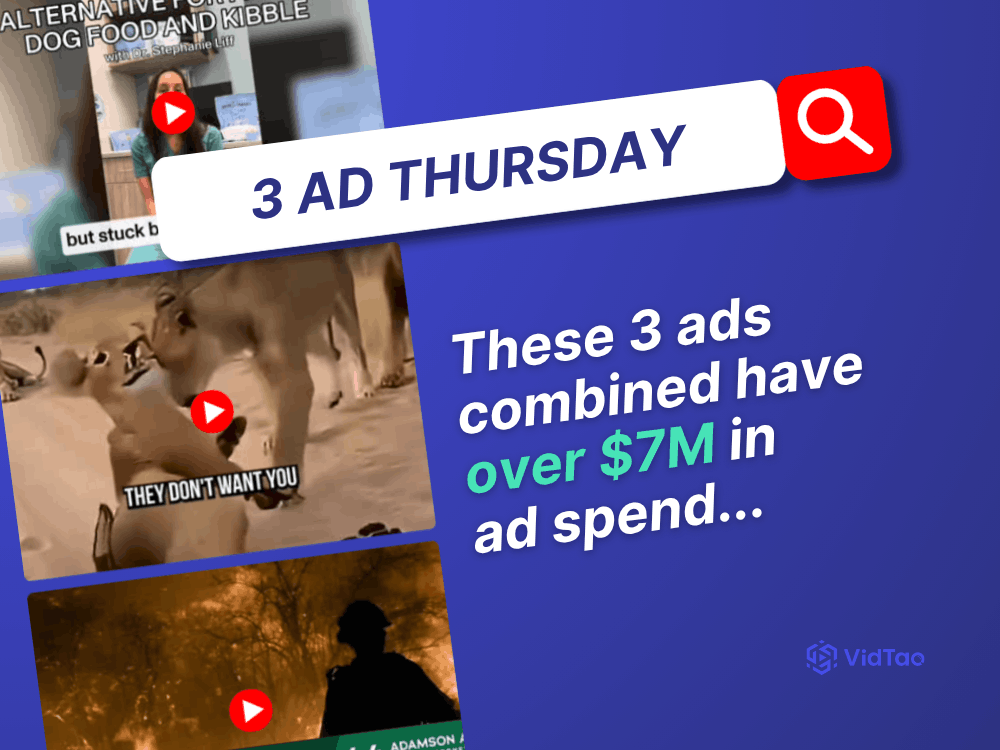
Welcome to, or welcome back to this week’s VidTao 3 Ad Thursday, where each week we’ll be diving into our VidTao ad spy tool to uncover 3 high-performing YouTube ads driving results!
This week we’ve got three high-performing YouTube ads for you to check out & model, including:
 Dog food ad with over $3M in ad spend (Spot & Tango)...
 Wildfire litigation legal services ad (Over a million in ad spend)...
 Car accident settlement lead gen ($2.6M+ in ad spend)...
Ready to check the ads out?
Let's dive right in and take a closer look at this week's YouTube ad standouts and discover what makes them so successful.
Dog food ad with over $3M in ad spend (Spot & Tango)
First up for this week is a dog food ad, with over $3M in ad spend:

These are some of the elements that make this ad work so well:
Hook "Are you trying to feed your dog better but stuck between overpriced fresh food and low-quality kibble?"
The hook frames the entire market as a forced choice between two unsatisfying options - premium fresh food that costs too much, and convenient kibble that's low quality. This is a classic "trapped between two bad options" setup, and it's effective because it mirrors the real internal debate of a conscientious pet owner. By defining the problem this way, the ad pre-builds the slot that the product will fill: a third option that resolves the tension.
 Vet Authority "Hi, I'm Dr. Stephanie Liff, Spot & Tango's vet advisor and a licensed veterinarian in New York City... I even feed it to my own dog."
Leading with a credentialed vet does the heavy credibility lifting for a category where pet owners are increasingly skeptical of marketing claims. The specificity (licensed, NYC, named) makes her verifiable rather than a generic actor in scrubs. The strongest line is "I even feed it to my own dog" - it converts a professional endorsement (which the audience knows is paid) into personal behavior (which feels like genuine proof). A vet putting her own pet on the product is the trust signal that disarms the "she's just being paid to say this" objection.
 The Mechanism "Spot & Tango is cooked at a low temperature to maintain 99% of the nutrients."
The low-temperature cooking explanation gives the quality claim a concrete reason to be true. By contrasting it with traditional kibble's high-heat cooking that's "destructive to the nutrients," the ad creates a simple, believable mechanism the viewer can understand and repeat to themselves. The "99% of the nutrients" figure and the close-up product visuals make the abstract idea of "better food" tangible. This is the rational backbone that justifies the premium-over-kibble positioning.
 The Third-Option Positioning "UnKibble maintains the same benefits as fresh or raw food... but here's the difference. It's shelf stable. No freezer, no cooking, and no mess."
This is the strategic core of the ad. Rather than competing head-on inside the kibble category or the fresh-food category, UnKibble claims a new position: all the benefits of fresh/raw (healthier digestion, shinier coat, improved appetite) with none of the friction (no freezer, no cooking, no mess). The big red X's over a freezer and a cooking pot make the "without the downsides" claim visual. It's a both/and pitch - you don't have to choose between quality and convenience anymore.
 Price Reframe "It's typically 40% more affordable than fresh frozen dog food, which makes it the most accessible human-grade dog food on the market today."
Having raised the "overpriced fresh food" pain in the hook, the ad now closes that loop directly. Positioning UnKibble as 40% cheaper than fresh frozen reframes it as the smart-value choice rather than another premium splurge. "Most accessible human-grade dog food" packs a lot into one phrase - human-grade (quality) plus accessible (affordability) - neutralizing the cost concern while keeping the premium quality halo.
 The Close "I've personally seen UnKibble help picky eaters, pets with allergies... use the code LIFF50 for 50% off your first order."
The close stacks a final round of use-case proof (picky eaters, allergy pets, senior pets with more energy) before the offer, letting different segments of dog owners self-identify. The personalized discount code (LIFF50, tied to Dr. Liff's name) reinforces the testimonial framing — it feels like her code, an extension of her recommendation, rather than a generic brand promo. The 50% off first order is a strong trial-driving offer that removes the financial risk of switching.
This advertiser has other cool, high-spending ads to model after as well, don’t miss out:
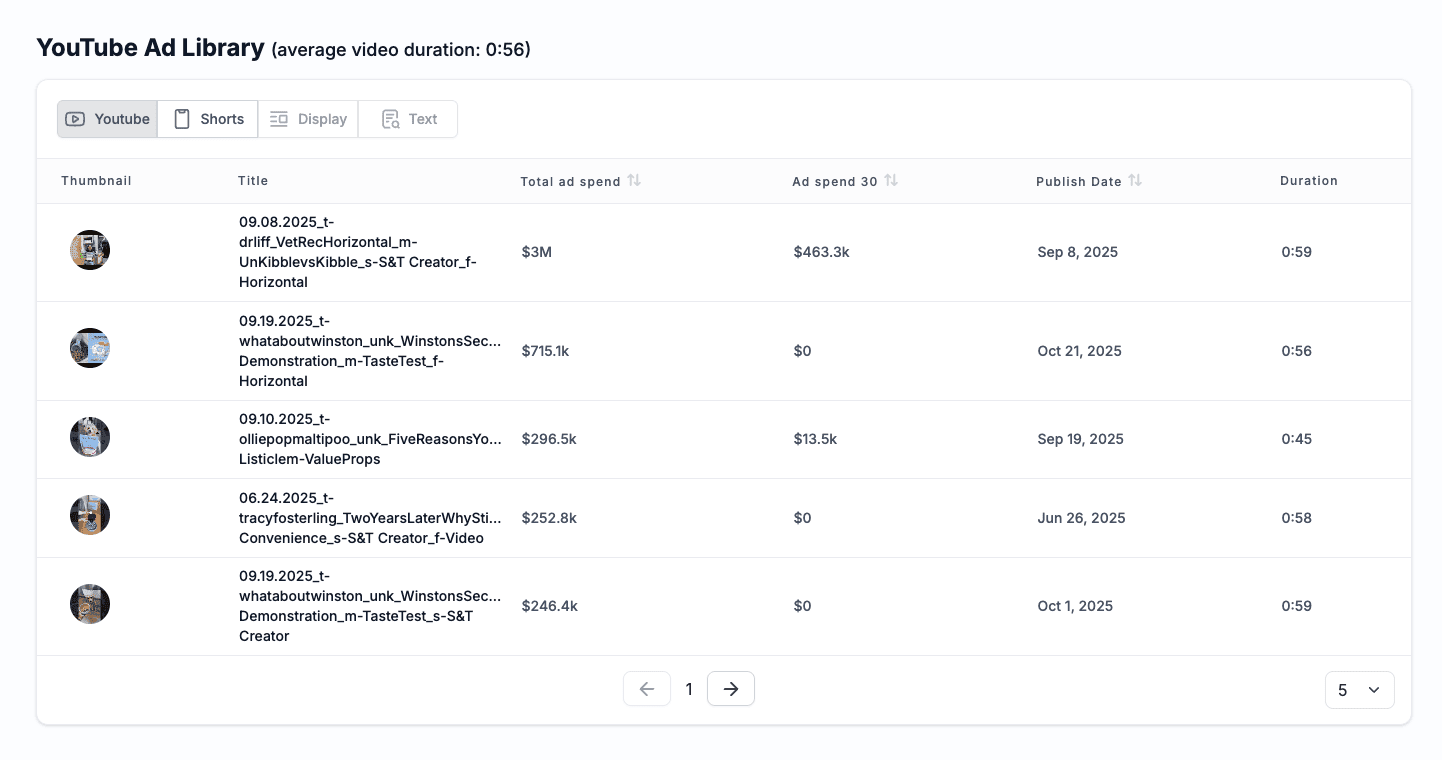
 Why this ad works
The vet endorsement is built to survive skepticism: Pet owners know vet endorsements can be paid, so the ad preempts that with "I feed it to my own dog." Personal behavior is harder to dismiss than a professional opinion, and it's the single most persuasive beat in the ad.
Third-option positioning sidesteps competition: By framing the market as a trap between two flawed choices and presenting itself as the resolution, the product avoids being compared directly against either category. It's not "better kibble" or "cheaper fresh food" - it's a new thing that makes the old trade-off obsolete.
Every objection is closed in sequence: The hook raises cost and quality concerns; the mechanism answers quality; the price reframe answers cost; the convenience claims answer the hassle of fresh food. By the end, each hesitation a pet owner might have has been addressed in order.
Wildfire litigation legal services ad (Over a million in ad spend)
Next up, this wildfire litigation legal services ad we found inside VidTao, with over a million in ad spend!

Here are some of the elements this ad consists of:
Hook "The Eaton fires left destruction in their wake, but your fight isn't over."
The hook pairs real, emotionally charged fire footage - helicopters, burning hillsides - with a direct address to a specific, geographically defined community. This is highly targeted disaster-response advertising: it's only shown to people in the affected area, so the footage is instantly recognizable as their event. "Your fight isn't over" is the pivotal reframe - it takes an event the viewer likely considers finished and reopens it as an active opportunity to recover more.
Broad Qualification "Even if your property didn't burn, you may still have a claim."
This single line is the ad's most important strategic move. The obvious audience for a wildfire legal ad is people whose homes burned down - a relatively small group. By explicitly stating "even if your property didn't burn," the ad expands eligibility to a vastly larger pool: anyone who evacuated, lost business income, or experienced smoke damage. It preempts the viewer's instinct to think "this doesn't apply to me" and keeps them watching.
 Audience Expansion "Whether you're a homeowner, business owner, or even a renter, you could be entitled to compensation."
Naming three distinct segments on screen - with "even a renter" called out specifically - captures people who would normally assume legal recovery isn't available to them. Renters in particular tend to self-disqualify from property-related claims, so explicitly inviting them widens the funnel. The list of recoverable damages (evacuation costs, business interruption, smoke damage, emotional distress) gives each segment a concrete reason to believe they qualify.
The Beyond-Insurance Reframe "You deserve full compensation for your losses, not just what insurance covers."
This positions the firm against the viewer's existing option (their insurance payout) rather than against other lawyers. It plants the idea that whatever insurance offered isn't the full amount they're owed - creating dissatisfaction with a settlement they may have already accepted or been offered. "You deserve" adds a layer of entitlement and validation that motivates action beyond pure economics.
 The CTA "Contact Adamson Ahdoot today or visit __ for a free consultation. You pay nothing unless we win."
The close is clean and frictionless, appropriate for a 30-second spot. The on-screen QR code with "scan to call now" removes the effort of remembering a number or typing a URL - one scan connects directly. "Free consultation" and "you pay nothing unless we win" (the standard contingency-fee reassurance) eliminate cost and risk. The compliance disclaimers running along the bottom signal this is an established, legitimate firm rather than a fly-by-night operation.
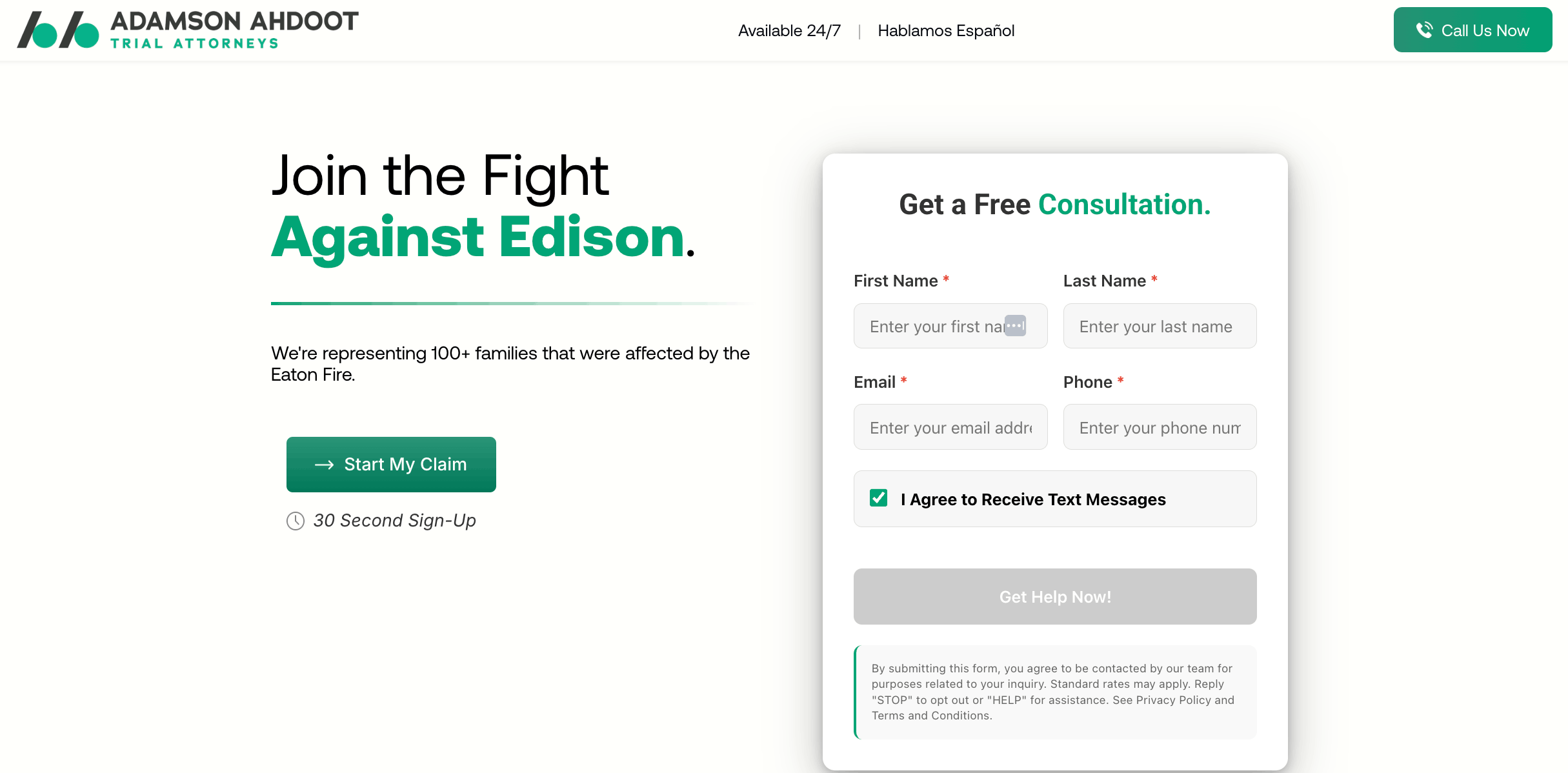
Here’s what this advertiser’s landing page in use looks like:
Why this ad works
Broad qualification maximizes the funnel: The entire economics of legal lead gen depend on the size of the eligible pool. By repeatedly widening who might qualify - didn't burn, renters, smoke damage, emotional distress - the ad converts a narrow disaster into a broad addressable audience without overpromising.
Geo-targeted footage creates instant relevance: Because the ad is served to people in the affected area, the real fire footage isn't generic B-roll - it's their disaster. That immediate recognition does the emotional work that a cold audience would never feel.
The beyond-insurance angle manufactures a reason to act now: Many viewers will have already dealt with insurance and consider the matter closed. Reframing insurance as insufficient reopens the decision and gives even "resolved" victims a motive to call.
Car accident settlement lead gen ($2.6M+ in ad spend)
Last but not least - a car accident settlement lead gen ad, with a pretty high spend:

 Hook "They don't want you to know about it."
This is the most unconventional element of the ad and the most strategically interesting. Distorted deep-voice narration played over completely unrelated lion footage has nothing to do with car accidents — and that's precisely why it works as a scroll-stopper. It mimics the aesthetic of conspiracy/forbidden-knowledge content that performs well on social feeds, triggering curiosity before the viewer realizes it's an ad. The jarring tonal switch to a polished spokesperson at 0:03 then re-anchors it as legitimate. It's a bait-and-reframe: grab attention with pattern-interrupt weirdness, then convert with professional credibility.
 The Setup "You might get a big cash payout if you were in a car accident up to 1 year ago. Even if you weren't driving."
The offer is stated immediately and simply — money, recent timeframe, low effort (five questions, 30 seconds). "Even if you weren't driving" is the first qualification-widening move, signaling early that the viewer shouldn't self-disqualify. The money-background visual behind the spokesperson reinforces the payout theme before any details arrive.
Broad Qualification "Even if you were a pedestrian, rideshare user, cyclist, or motorcyclist, you can get the justice you deserve."
As with the other legal lead gen ads in this series, the addressable pool is deliberately expanded by naming every category of person who might have been involved in a traffic incident without driving. Each named group is a segment that would otherwise assume the offer isn't for them. The goal is to make the maximum number of viewers think "that could be me."
 Proof Through Specificity "Look at Meo for example... she got over $160,000."
The named-example-plus-check-image is the ad's credibility anchor. A specific name (Meo), a specific figure ($160,000), a specific timeframe ("less than a year ago"), and a visual of an actual settlement check transform the abstract promise into something concrete. The framing "she had no idea her case was worth anything" is designed to make the viewer think their own dismissed situation might also be valuable.
 Objection Preemption "Some people feel bad about holding someone accountable... Don't let that be you. You deserve compensation. It's your right."
This is the most psychologically targeted beat. The biggest barrier to personal-injury claims isn't awareness — it's the guilt of feeling like you're being litigious or "scamming the system." The ad names that exact hesitation and reframes claiming as exercising a right rather than causing trouble. "If the accident wasn't your fault, you shouldn't be punished" completes the moral permission structure.
 Aspirational Close "Just imagine having an extra $10,000 or even $100,000 right now... pay off your bills, get a new car, take a vacation."
The close deliberately shifts away from injury and toward lifestyle fantasy. Rather than dwelling on medical bills or pain, it paints a vivid picture of what the money enables — debt paid off, a new car, a vacation, treating yourself. This is desire-based selling layered on top of a legal offer. The repeated low-friction CTA (five questions, 30 seconds, specialist contacts you, paid only if you win, check in as little as 30 days) removes every remaining barrier.
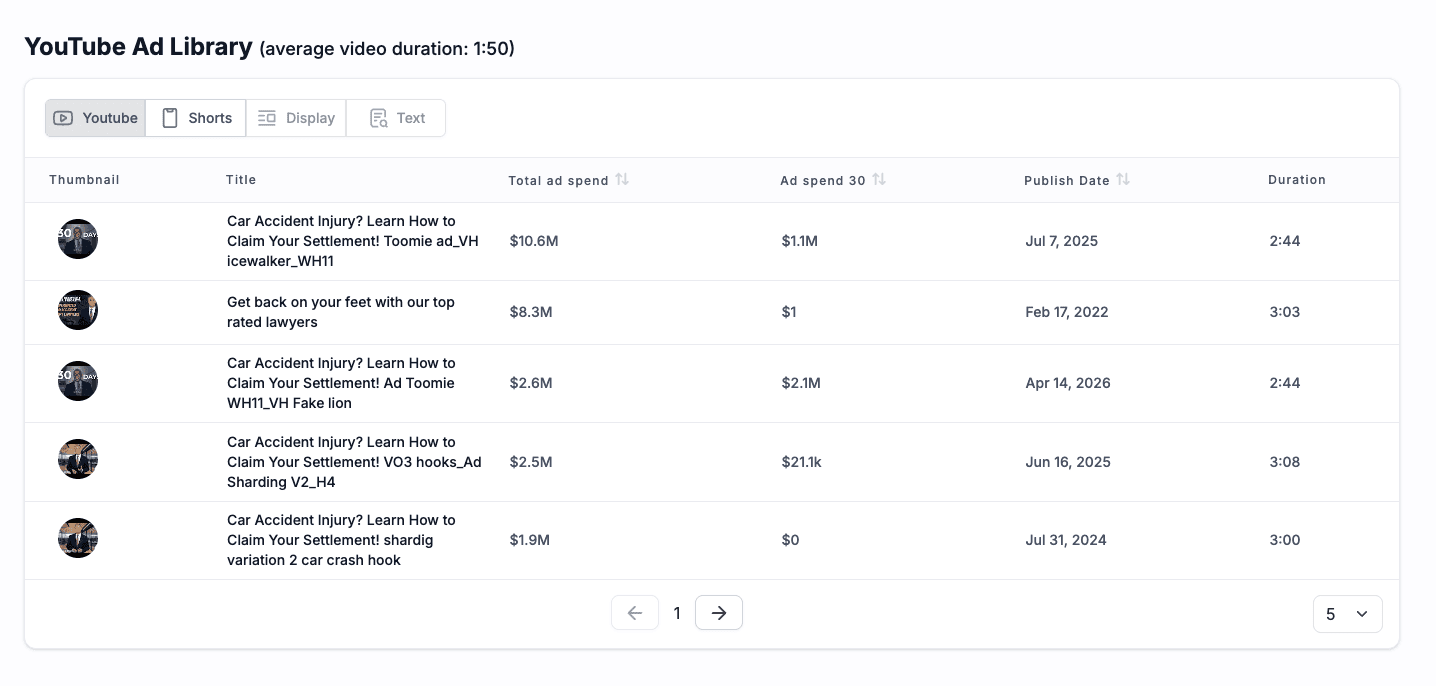
This advertiser has many other ads with high spend - and we’re talking millions!
Check them out as well:
Why this ad works
The pattern-interrupt hook buys attention the offer couldn't: A straightforward "were you in a car accident?" opener gets scrolled past instantly because viewers are trained to ignore legal ads. The conspiracy-style lion intro is weird enough to stop the thumb, and the reframe to a credible spokesperson catches the viewer once they're already watching.
Specific proof beats vague promise: The named Meo example with a visible six-figure check does what no general claim can - it makes the payout feel real and achievable. Specificity is the currency of belief in a category drowning in "you may be entitled to compensation."
Guilt-removal unlocks a stuck audience: Many qualified claimants never act because filing feels greedy or troublesome. By naming and dissolving that guilt, the ad converts hesitant viewers who were never going to be moved by the money alone.
 "Spy" on 42M YouTube Ads
(plus Landing Pages)!
Unlock proven strategies for success with the VidTao Premium YouTube Ad Library. Get instant access to your FREE VidTao trial today 
 Claim Your FREE VidTao Trial Now!
Take the guesswork out of YouTube ads – start scaling smarter.
We're all done for this week! 
We hope this week’s selection of high-performing ads has sparked new ideas to test yourself!
Want more insights like these?
Stay tuned for next week’s VidTao 3 Ad Thursday, where we’ll continue breaking down winning strategies from the best YouTube ads in the game!