

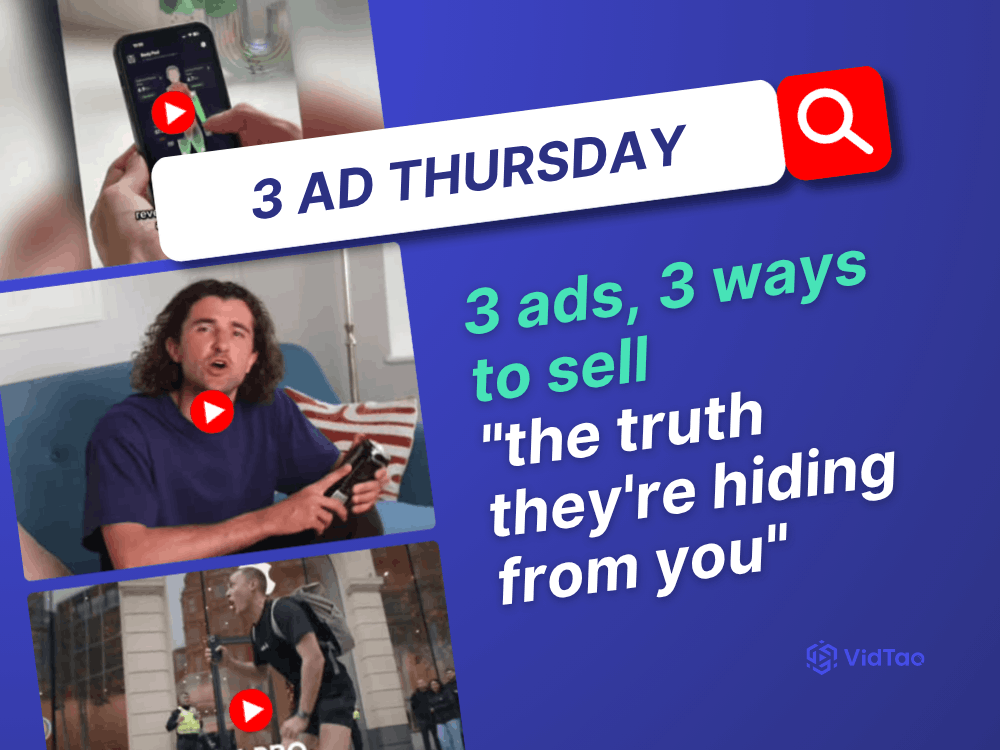
Welcome to, or welcome back to this week’s VidTao 3 Ad Thursday, where each week we’ll be diving into our VidTao ad spy tool to uncover 3 high-performing YouTube ads driving results!
This week we’ve got three high-performing YouTube ads for you to check out & model, including:
 A very dynamic iPhone case ad (over $100k in ad spend)...
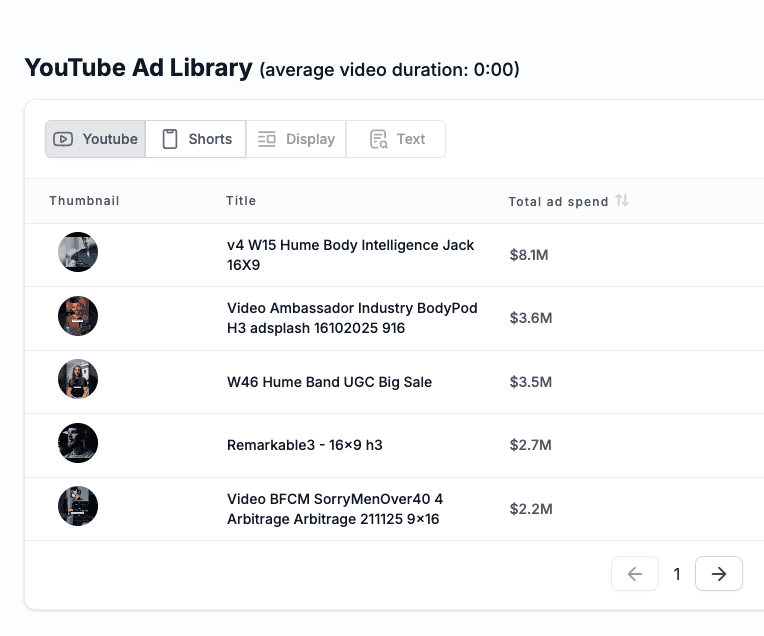
 Smart body composition scanner ad by Hume ($8M in ad spend!)...
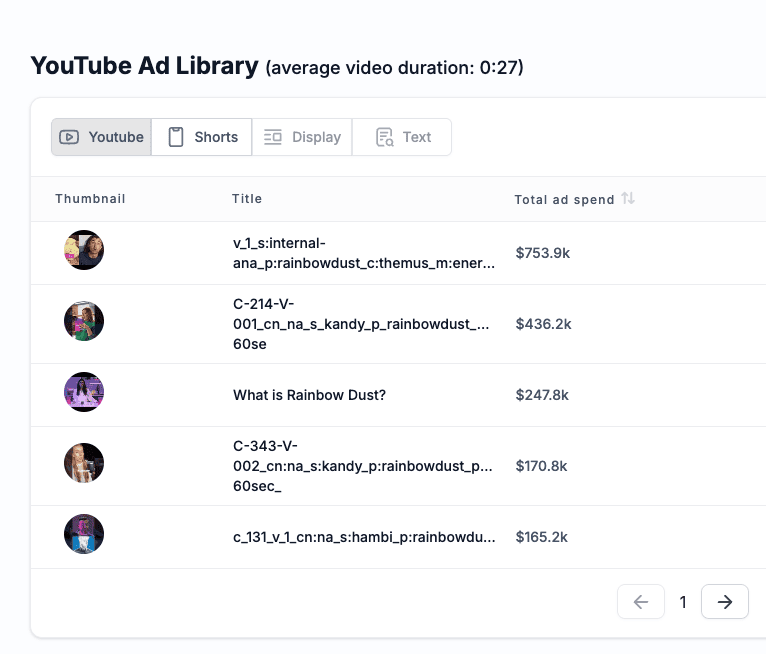
 Space Goods rainbow dust blend ad (over $700k in ad spend)...
Ready to check the ads out?
Let's dive right in and take a closer look at this week's YouTube ad standouts and discover what makes them so successful.
A very dynamic iphone case ad (over $100k in ad spend)
Our first ad pick this week is a very dynamic, loud and active iphone case ad:

Let’s now analyze it part by part:
 Hook "This is the iPhone 16 Pro and this is melting."
The line is almost anti-hype in its delivery - flat, matter-of-fact - which contrasts with the visually dramatic stress test playing simultaneously. Combined with rapid cuts and upbeat music from frame one, it signals "native platform content" rather than "advertisement,"
Chapter One: Phone Cases "We started by disrupting phone cases. People told us the category was too crowded and it wouldn't work. What happened? We built a global brand shipping over 100 million pounds in phone cases alone and partnering with one of the biggest companies in the world, Google."
This establishes the ad's recurring rhetorical device: state the doubt in the second person plural ("people told us"), then answer it with one large, named, verifiable proof point. Showing the literal Google rooftop and a Pixel phone being tested reinforces the partnership claim visually rather than just verbally.
 Chapter Two: Backpacks "Then we launched backpacks. Again, people weren't sure - it's a competitive market, you're not credible, why would anyone buy a backpack from Mous? Well, we've just become the official supplier for the Mercedes AMG Petronas Formula 1 team, and in March this year backpack revenue was nearly three times higher than March 2024."
The same doubt-then-proof structure repeats, but the proof escalates in prestige (an F1 team partnership carries significant brand cachet) and adds a hard growth statistic. Repeating the exact rhetorical pattern from Chapter One trains the viewer to expect,and trust - the next payoff before it even arrives.
 Chapter Three: Luggage "So now we're going after luggage, built with material experts to withstand something like this."
This chapter is shorter and forward-looking rather than proof-backed (since the product is new), but it's placed directly after two proven wins, borrowing credibility by association - the viewer has just watched two doubted categories succeed, so a third doubted category feels like a formality rather than a risk.
 The Philosophical Pivot "This isn't about luggage or phone cases or backpacks. It's about a mindset. Because when you're this relentlessly obsessed with designing products that actually enhance people's lives, when every stitch, thread, and circuit is engineered to perform, people take notice."
This is the ad's most strategically important beat. After three rounds of concrete, checkable proof, it deliberately abstracts away from SKUs and financials toward identity and obsession - repositioning the entire ad from "here's what we sell" to "here's who we are," which is a much stickier, more shareable takeaway than any single product claim.
 Close "From living in China to global partnerships, and honestly, we're only just getting started... whatever you're chasing, wherever you're going, we'll be right there with you. Mous. Live without limits."
The close ties the founder-origin detail ("living in China") to the brand's global scale today, then hands the aspirationalframing directly to the viewer ("whatever you're chasing"), turning a company success story into a personal one the viewer is invited to project onto.
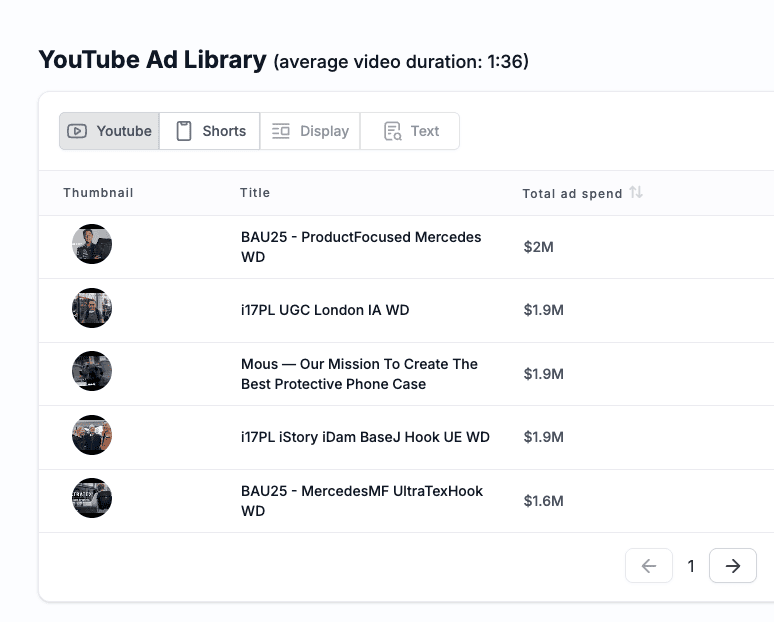
Mous actually has many other amazing ads, with very high spends that you can also check out using VidTao:
 Why this ad works:
- Native pacing and editing earns attention platforms increasingly reward: The fast cuts, on-screen stress tests, and upbeat music match organic top-performing content style rather than traditional ad grammar, which likely improves watch-through and reduces skip rate.
- Repeating the doubt-then-proof structure builds compounding trust: Because the same rhetorical pattern pays off twice before the third (unproven) category appears, the viewer extends the same trust to luggage without needing separate evidence - proof momentum substitutes for direct proof.
- Naming real, recognizable partners (Google, Mercedes AMG Petronas F1) raises the stakes of the claims: Vague growth language is easy to dismiss; a named F1 team supplier deal is not, and it's the kind of claim a skeptical viewer could actually verify, which builds unusually high credibility for a DTC ad.
Smart body composition scanner ad by Hume ($8M in ad spend!)
This next ad is for a smart scale that can scan your entire body composition, check it out:

Let’s now analyze it:
 Hook "The Body Scanner reveals the brutal truth about your body that your regular scale will never tell you."
Delivered over a foot stepping onto the device, this line sets up an information asymmetry: your current tool is hiding something from you, and this one won't. Forbidden knowledge, without the shock visual.
 The Frustration "For weeks, my scale showed I wasn't losing weight despite diet and exercise. I was about to give up until I discovered the Hume Body Pod."
This names a specific, widely-shared fitness experience (working hard, seeing no scale movement, considering quitting) before the product appears. This uses a relatable near-failure moment to build empathy and make the eventual "discovery" feel earned rather than staged.
 Authority Stacking "This isn't just another smart scale. It's a complete body intelligence system used in over 12,000 health clinics worldwide. Now available for your home."
This is the pivot from consumer gadget to clinical tool. It borrows legitimacy by positioning the home product as a trickle-down version of something previously exclusive to professionals.
 The Demo "The moment I stepped on it and grabbed the handles, it sent safe electrical currents through my entire body, scanning and analyzing my arms, legs, and torso with 98% DEXA accuracy."
The visual of glowing electrical current lines running up the legs on screen makes an invisible process (bioelectrical impedance analysis) feel dramatic and almost sci-fi, while "98% DEXA accuracy" anchors the claim to a real, recognizable clinical gold-standard (DEXA scans), which most viewers won't be able to verify but will recognize as a credible benchmark.
 The Reveal "What I discovered changed everything. While my weight hadn't changed, I'd actually lost 7 lbs of fat and gained six pounds of muscle."
This is the ad's strongest beat and its actual product-market fit argument: the number on a regular scale can mask real progress (fat loss offset by muscle gain), which is both scientifically accurate and emotionally resonant for anyone who's felt discouraged by a stalled scale despite visible effort.
 Data Depth "The Body Pod measured body fat, muscle mass, water, metabolic age, and 40 other metrics, showing me exactly how my body was responding to different diets, workouts, and routines. No more guesswork or frustrating plateaus."
Naming a large, specific metric count ("40 other metrics") alongside a phone screen showing muscle/fat/BMI/body water breakdowns turns an abstract "more data" claim into something that looks measurable and comprehensive on screen.
 Close "Top doctors, dieticians, and elite athletes all swear by the Body Pod for accurate results. So I recommend you get your Body Pod now while they still have the special discount."
The close leans on professional endorsement one final time before a mild, low-pressure discount nudge - notably gentler than this month's legal or wellness ad closes, fitting a higher-consideration, higher-price health tech purchase rather than an impulse buy.
This advertiser has really cool, high-spending ads you can model after as well, don’t miss out:
Why this ad works:
- Naming a real, widely-felt frustration before pitching the fix builds instant relevance: "Diet and exercise but the scale won't move" is one of the most common fitness complaints, so the ad doesn't need to manufacture a problem - it just needs to name one the audience already has.
- The recomposition reveal reframes failure as hidden success: Rather than promising future results, the ad retroactively reinterprets a demoralizing plateau as evidence the method was working all along — a uniquely comforting angle in a category full of "you're not trying hard enough" messaging.
- Borrowed clinical authority (DEXA, 12,000 clinics) raises perceived accuracy for a device most viewers can't independently verify: Specific numbers and named clinical benchmarks do the credibility work that a generic "highly accurate" claim couldn't.
Space Goods rainbow dust blend ad (over $700k in ad spend)
Last but not least, a ‘rainbow dust’ blend ad by Space Good:

Let’s dissect this ad as well and see what makes it work so well:
 Hook "Let's actually take a look at what's inside one of these energy drinks."
Holding an actual, recognizable competitor can (Monster) and reading its real label on screen makes this feel like consumer journalism rather than advertising. The word "actually" signals to the viewer that most people don't bother checking this, positioning the presenter as doing the audience a favor rather than selling to them.
 The Teardown "Starts off with carbonated water, then sugar, then more sugar. So basically, fizzy diabetes. Natural flavors, whatever that means, and a bunch of things that no one can pronounce, but sounds well sciency. And we just nod and drink it all anyway."
This is a comedic, plain-language translation of an ingredient label most viewers have seen but never actually parsed. The on-screen label (caffeine content, ingredient list) makes the mockery feel evidence-based rather than exaggerated, and "we just nod and drink it anyway" implicates the viewer gently, priming them to want an alternative before one is even offered.
 Visual Consequence (stomach/digestive system graphic shown while discussing the drink's contents)
Rather than a testimonial or before/after photo, the ad inserts a brief anatomical visual to imply internal impact without making an explicit health claim - a subtler, less legally risky version of the fear-based imagery used in some wellness ads.
The Turn "And now, compared to this Rainbow Dust by Space Goods, this is what I drink now. No preservatives, no sugar, no lab experiment energy crash. Just seven ingredients that actually do something."
The product is introduced only after the competitor teardown is complete, and immediately framed in direct opposition to everything just criticized (preservatives, sugar, unpronounceable ingredients). "Just seven ingredients" implies simplicity and restraint, positioning fewer ingredients as inherently more trustworthy than a longer list.
 Ingredient Walkthrough "Lion's Mane 1,000mg proper brain fuel. Cordyceps 1,000mg clean energy no wobbles. Chaga 1,000mg immune support. Ashwagandha 200mg to take the edge off life. Maca Root 250mg for mood, stamina, and maybe your sex life if you're lucky. Coffee extract 80mg same caffeine hit with no chaos. Vitamin B5 so you don't feel a zombie midday."
Naming a specific milligram dose for each ingredient (shown on screen with icons and one-line benefit tags) mirrors the transparency framing from the opening teardown - the ad is essentially saying "here's the label, and unlike theirs, ours is easy to understand and justify item by item." The casual, joke-laced delivery ("maybe your sex life if you're lucky") keeps the tone consistent with the informal, skeptical-friend voice established at the start.
 Reassurance "All third-party tested, all naturally sourced, and actually tastes like a belter of a coffee."
This addresses two common objections to functional/adaptogen products in one line: trust (third-party testing) and palatability (taste), both of which are common purchase barriers for this category that a pure ingredient list doesn't resolve on its own.
 Personal Before/After "I used to have one of these before the gym or when I had a million tabs open with no will to live. Now I have one scoop of Rainbow Dust in the morning and I'm golden for hours."
A light, self-deprecating personal narrative reframes the switch as a lifestyle upgrade rather than a health intervention, keeping the tone consistent with the ad's overall conversational register rather than escalating into medical claims.
 Close "Try it risk-free. 60-day money back guarantee. Swap one of your energy drinks for Rainbow Dust and actually win your day without the crash. Save 68%. Space Goods."
The ask is framed as a low-stakes substitution ("swap one of your energy drinks") rather than a lifestyle overhaul, paired with risk removal (money-back guarantee) and a discount, closing on ease rather than urgency.
Again, you can browse VidTao and see more ads by this advertiser for some additional inspo:
Why this ad works:
- Mocking a familiar competitor label builds credibility through specificity, not claims: Reading an actual, recognizable product's real ingredients aloud is far more persuasive than a generic "other energy drinks are bad for you" statement, because the viewer can verify it themselves.
- Matching ingredient transparency to the standard set by the teardown creates a fair, self-imposed test: Having just criticized an unclear label, the ad has to (and does) hold its own product to the same standard, which makes the pitch feel consistent rather than hypocritical.
- A conversational, joke-forward tone lowers resistance in a skeptical category: Functional mushroom/adaptogen products often trigger "snake oil" skepticism; a casual, self-aware delivery style ("maybe your sex life if you're lucky") signals the presenter isn't taking himself too seriously, which paradoxically makes the health claims feel more trustworthy.
 What if you could search VidTao by hook?
Not keywords. Not brand names. The actual hook type: problem agitation, pattern interrupt, bold claim, curiosity gap…
Imagine one search inside VidTao:
"Vertical UGC-style ads in my niche, problem-agitation hook, before/after proof, aimed at problem-aware audiences, sorted by total spend."
…and it just shows you the winners.
 VidTao 3.0 is coming, and this is just one of the new features. Stay tuned.

VidTao 3.0 preview
We're all done for this week!
We hope this week’s selection of high-performing ads has sparked new ideas to test yourself!
Want more insights like these?
Stay tuned for next week’s VidTao 3 Ad Thursday, where we’ll continue breaking down winning strategies from the best YouTube ads in the game!