

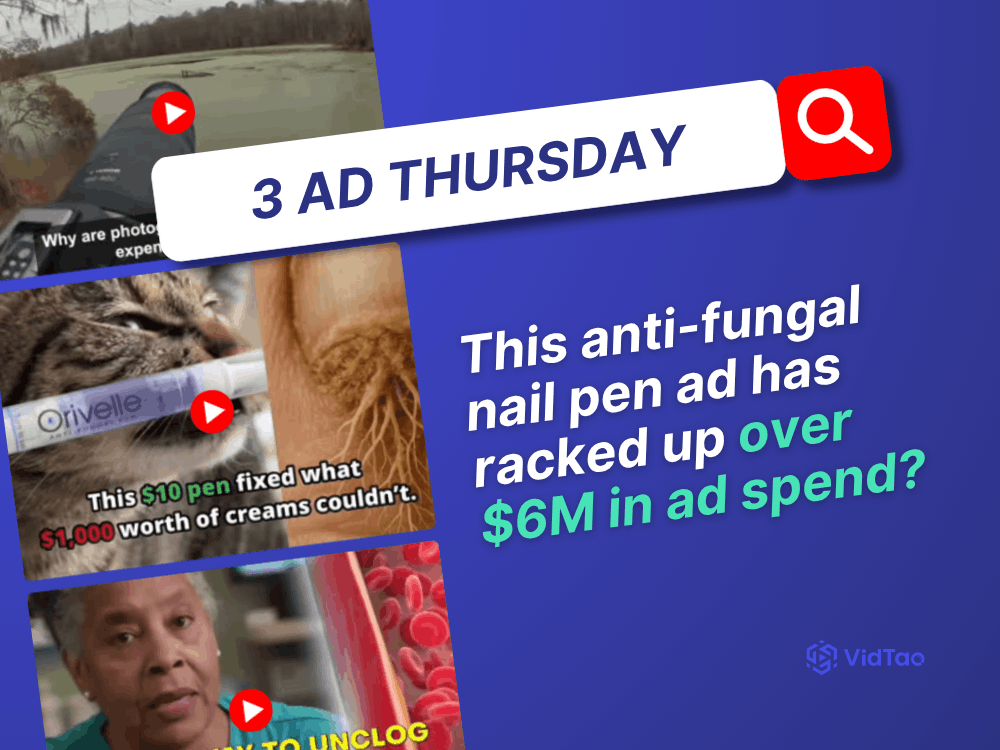
Welcome to, or welcome back to this week’s VidTao 3 Ad Thursday, where each week we’ll be diving into our VidTao YouTube spy tool to uncover 3 high-performing YouTube ads driving results!
This week we’ve got three high-performing YouTube ads for you to check out & model, including:
 Cardiovascular supplement ad with $3M in ad spend…
 Anti-fungal nail pen ad with over $6M in ad spend…
 Clip-on smartphone telephoto lens ad ($1.3M in ad spend)...
Ready to check the ads out?
Want to win a free year of VidTao ($797)?
Help us build VidTao 3.0 with your input by completing this 5-minute survey and you are entered to
win a free year of VidTao ($797)!
Let's dive right in and take a closer look at this week's YouTube ad standouts and discover what makes them so successful.
Cardiovascular supplement ad with $3M in ad spend
Our first ad pick to analyze this week is this cardiovascular supplement ad, check it out:

Here are some of the elements this ad consists of:
 Hook "Cut out salt? Nope. Take blood pressure meds? Nope. Follow the DASH diet? Nope."
The "NOPE" sequence does something rare - it makes the viewer feel vindicated before they've heard a single claim. Anyone who has tried these things and seen limited results experiences a small hit of recognition with each dismissal. The grayscale visuals of pills and salt reinforce the rejection visually. By the time "hold on to your chest" arrives, the viewer is primed to believe that what comes next is genuinely different from what they've already heard.
 Authority Framing "As an ER nurse, I see more heart attacks happen than most cardiologists."
The ER nurse choice is deliberate and sophisticated. Doctors in supplement ads are expected and slightly distrusted - they feel hired. A nurse feels like a witness. The line "I see more heart attacks happen than most cardiologists" is particularly strong because it positions her authority as experiential rather than academic, which is far more credible to an older audience that has been failed by conventional medicine.
 The Mechanism: Artery Cement "It's a dangerous cement made of cholesterol, calcium, and inflammatory toxins that harden like rocks in your arteries."
"Artery cement" is a masterclass in mechanism naming. It takes a real medical concept (arterial calcification) and gives it a name that communicates hardness, permanence, and danger simultaneously. The 3D artery animation with CHOLESTEROL, CALCIUM, and INFLAMMATORY TOXINS appearing in large red text makes the abstract viscerally visual. The toothpick analogy - "no medication can break through it, it's like trying to break rocks with a toothpick" - translates medical futility into something anyone can picture.
 Fear Escalation "Your organs slowly suffocate from lack of oxygen, triggering crushing fatigue, brain fog, swollen limbs, low libido, and skyrocketing blood pressure."
The symptom list is carefully constructed - fatigue, brain fog, swollen limbs, and low libido are things the target demographic (older adults) is already experiencing and has likely attributed to aging. Connecting those existing symptoms to artery cement transforms vague discomfort into a named, worsening crisis. The escalation to "sudden cardiac death" and the four-times statistic lands at the exact moment the viewer is most emotionally activated.
 Authority Transfer "I learned this artery secret from board-certified lipidologist Dr. Luis Martinez - the doctor cardiologists call when their patients are at death's door."
The double credentialing here is elegant. The nurse is relatable; Dr. Martinez is elite. "The doctor cardiologists call when their patients are at death's door" is one of the strongest authority lines in the ad - it positions him above the specialists the viewer already trusts, without requiring them to know what a lipidologist actually is.
 The Frictionless Close "You don't need to enter your email address or anything."
In a category where the audience is conditioned to expect spam after clicking any health link, this single line neutralizes the biggest conversion killer. Pairing it with the "free presentation" framing (not a sales page, not a product - a presentation) makes the click feel like consuming information rather than entering a funnel. The identity vision close - "imagine waking up tomorrow with clearer arteries, normalized blood pressure, no more artery cement slowly strangling your organs" - arrives after all friction is removed, so it lands on a viewer who has no remaining logical objection.
Here’s what this advertiser’s landing page in use looks like:

 Why this ad works
The mechanism does the selling: Once you believe "artery cement" exists and that standard treatments can't touch it, the product isn't competing against medication or diet - it's the only thing that addresses the actual problem. The naming creates a category of one.
Fear is earned, not manufactured: Every fear escalation beat is tied to something visual (the 3D animation, the heart scan reference) or something the viewer already feels (fatigue, brain fog). The ad doesn't invent anxiety - it gives existing anxiety a name and a villain.
The nurse is the strategic creative decision: In a category saturated with doctor-fronted VSLs, the ER nurse perspective feels like a leak from inside the system. She's not selling - she's warning. That tonal difference is what separates this from a dozen structurally similar heart health ads.
Anti-fungal nail pen ad with over $6M ($1.5M in the past 30 days…)
This next ad has racked up the incredible number of $6M in ad spend with over $1.5M spend only in the past 30 days:

So, what is their secret?
Let’s dissect this ad together: Hook "This $10 pen fixed what $1,000 worth of creams couldn't."
The price anchoring is the entire hook and it's doing sophisticated work. By naming a specific high number ($1,000 in failed creams), it validates that the viewer has likely already spent a lot and failed - then offers a $10 solution that reframes the product as almost insultingly cheap by comparison. The split-screen pairing a cute cat with a horrifying infected nail is a deliberate attention clash that makes both images more striking.
 Problem Visualization "This yellow crust is why your nail fungus won't go away."
The extreme close-ups of crusted, discolored nails would repel a general audience - which is exactly why they work. They act as a qualifying filter: anyone who keeps watching has recognized their own feet. The line "make you want to hide your feet in socks all year round" names the specific emotional cost (shame, concealment) rather than the medical symptom, which is what actually drives this purchase.
 The Mechanism Reframe "The root of the problem hides under hardened layers of keratin. It creates a thick shield."
"The keratin shield" is the ad's central creative idea. It reframes every past failure as not the viewer's fault and not even the product's fault - the treatments simply couldn't physically penetrate. The 3D nail anatomy animation with the red "no" symbol over a surface cream makes this abstract concept visual and believable. This single reframe accomplishes two things: it absolves the viewer of failure and discredits every competing product simultaneously.
 The Relatable Failure "I tried everything. Creams, soaks, even meds. Nothing worked."
The first-person failure narrative is what makes the UGC format convert. Before offering a solution, the presenter establishes that she was exactly where the viewer is now - frustrated, having wasted money, ready to give up. This shared-failure positioning means the eventual recommendation feels like a peer passing along a discovery, not a brand making a claim.
Authority Beat "A top foot care expert realized the industry had it wrong."
The white-coat expert appears briefly to lend institutional credibility to the keratin shield reframe. Notably, the expert is vague and unnamed - this ad leans far more on UGC relatability than on authority, so the expert is a supporting beat rather than the centerpiece. "The industry had it wrong" plays into the broader distrust-of-conventional-solutions theme the whole ad is built on.
 Solution Mechanism "It uses a precision tip to deliver fast-absorbing natural oils directly through the nail's defenses."
The product mechanism mirrors the problem mechanism perfectly - if the problem is that treatments can't penetrate the keratin shield, the solution is a precision tip that bypasses it. This symmetry is what makes the product feel like the obvious answer rather than just another option. "Natural oils, no harsh chemicals, no irritation" preempts the objection that a stronger treatment means more side effects.
 The Close "Click the link below to get up to 70% off today. It comes with a 30-day money-back guarantee."
The close stacks every conversion lever: the multi-person results montage (social proof), the Black Friday "ends today" banner (urgency), 70% off (discount), and the money-back guarantee (risk reversal). The "if you're tired of hiding your toes" callback returns to the emotional payoff - clear nails you're not embarrassed by - right before the ask, so the purchase is framed as buying relief from shame rather than buying a pen.
Orivelle has other cool high-spending ads as well, don’t forget to check out those as well:

Why this ad works
The mechanism removes blame: "The keratin shield" is the strategic core. It tells the viewer their past failures weren't their fault, which both relieves frustration and explains why this product is different. You can't sell to someone who thinks they've already tried everything unless you explain why everything else couldn't have worked.
The disgust visuals are a qualifier, not a flaw: Showing genuinely unpleasant infected nails filters the audience down to people who recognize themselves. For them, the gross-out is validation. General-audience squeamishness is irrelevant because they were never the buyer.
UGC format lowers the guard: The selfie footage and first-person failure story make this feel like a recommendation from someone who gets it. In a category full of clinical, embarrassing-to-research products, peer relatability is a competitive advantage.
 "Spy" on 42M YouTube Ads
(plus Landing Pages)!
Unlock proven strategies for success with the VidTao Premium YouTube Ad Library. Get instant access to your FREE VidTao trial today 
 Claim Your FREE VidTao Trial Now!
Take the guesswork out of YouTube ads – start scaling smarter.
Clip-on smartphone telephoto lens ad ($1.3M in ad spend)
Last but not least - this clip-on photo lens ad caught our attention:

These are some of the elements this ad includes: Hook "Why are photographers ditching their expensive cameras for this NASA super zoom lens?"
The hook uses the "experts are secretly switching" structure, which works because it implies the viewer is about to learn something insiders already know. It positions the product against a clear, expensive enemy (DSLR cameras) and frames the cheap alternative as the smart choice the pros have quietly made. Dropping "NASA" in the first line establishes the credibility anchor before any claim has to be defended.
 Borrowed Authority "This invention is the result of inspiration from the Stargazer lens, a breakthrough device developed by NASA."
NASA is the load-bearing credibility pillar of the entire ad. The audience won't fact-check whether a "Stargazer lens" exists - the association alone does the work. Linking a $20 phone clip to space-grade optics is a massive perceived-value transfer, and it preempts the obvious objection ("how can something this cheap zoom that well?") by implying the technology was developed by people who put telescopes in orbit.
 The Origin Story "John Bucker, a retired NASA engineer, saw the opportunity to adapt NASA's Stargazer lens technology for everyday use."
The named inventor gives the product a story and a reason to exist. A retired NASA engineer "taking his notes from NASA" to build something for ordinary people is a classic origin-story arc - it frames the product as a deliberate invention born from expertise, not a generic import. It also adds a likability layer: a scientist who wants regular people to have access to technology that was previously expensive.
Demonstration Through Use Cases
Instead of dwelling on specs, the ad rapidly shows the lens in different scenarios - wildlife, sports, astronomy, dangerous animals at a safe distance. This is smart segmentation: each use case is a hook for a different buyer. The bird-watcher, the sports fan, and the amateur astronomer all see their specific use reflected. Showing the phone screen with the magnified image provides the visual proof that the 200x claim is doing something real.
 Social Proof Through Virality "The invention quickly went viral, with buyers posting amazing images on social media."
Framing the product as already-viral does two things: it provides social proof (other people bought it and love it) and creates FOMO (everyone else already knows about this). "Even professional photographers prefer it as an alternative to bulky lenses" loops back to validate the hook's original claim, closing the narrative circle.
 The Scarcity Close "It sold out within the first 48 hours... a 50% welcome-back sale for anyone who orders within the next 24 hours."
The close is a maximalist stack of urgency mechanics: prior sellout (proof of demand), tripled production (responding to demand), 50% off (discount), 24-hour window (deadline), QR code (frictionless action), "not on Amazon or in stores" (exclusivity + anti-knockoff framing), and a 90-day guarantee (risk reversal). The final line - "or you risk paying full price again tomorrow" - converts the discount into a loss-aversion trigger. It's not "save 50%," it's "don't lose this price."
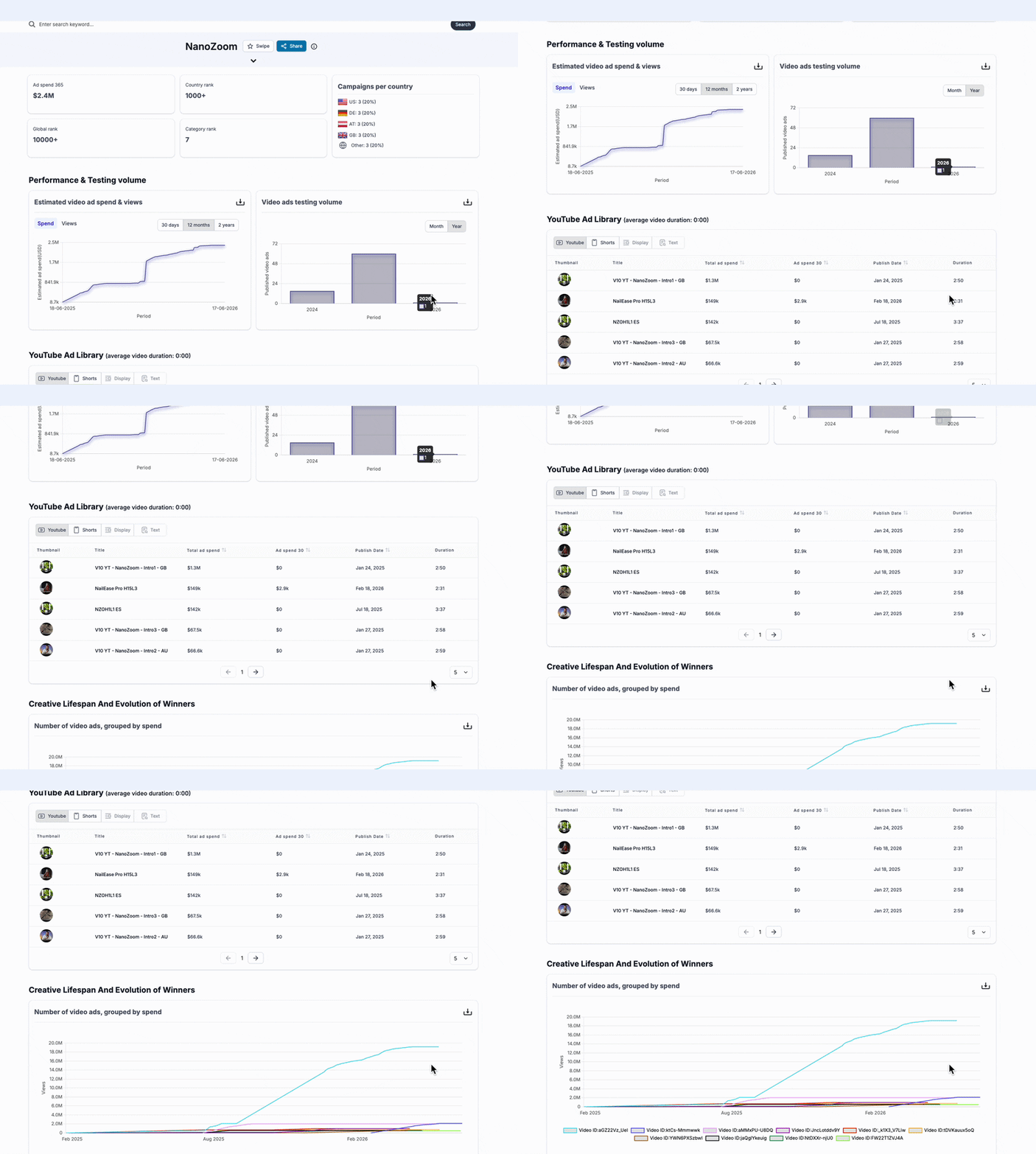
See more ads + stats on this advertiser using VidTao! Here’s a sneak peek:
Why this ad works
Borrowed authority shortcuts trust: Building credibility for an unknown gadget brand from scratch is slow. Attaching it to NASA instantly imports decades of accumulated trust in a single word. The audience extends NASA's credibility to the product without the brand having to earn it.
The enemy makes the value obvious: By positioning against expensive DSLRs and bulky professional lenses, the ad gives the viewer a clear price-and-convenience comparison where NanoZoom wins on every axis - cheaper, smaller, easier. The product doesn't have to be good in absolute terms, just better than the strawman it's compared to.
Use-case variety widens the funnel: Rather than targeting one buyer, the rapid montage of scenarios lets multiple audience segments self-identify. This broadens the addressable market within a single ad without diluting the message.
Want to brainstorm with us on new ways to scale your business with
YouTube Ads (and other performance video platforms)?
Join us for a free YouTube ad brainstorming session here:
We're all done for this week!
We hope this week’s selection of high-performing ads has sparked new ideas to test yourself!
Want more insights like these?
Stay tuned for next week’s VidTao 3 Ad Thursday, where we’ll continue breaking down winning strategies from the best YouTube ads in the game!
And btw… If you have questions about YouTube ads?
Go here to schedule a free chat with our friends at Inceptly. Inceptly is a top Direct Response video ad agency, specializing in high-performing YouTube ad creatives & media buying.
Have a great week!
PS - Go here to Claim Your Free Trial of VidTao Premium: Access 40 Million YouTube Ads & Their Landing Pages!
PPS - Are you spending $1k/day+ on Paid Ads?  Go here to set up a free YouTube Ad brainstorm chat.